Understanding MIG vs TIG welding is essential before choosing the right process for fabrication or repair work. Different types of welding offer unique advantages depending on the material, application, and finish required. Ansari Steel answers the most common questions to help you select the most suitable welding method for your project with confidence.
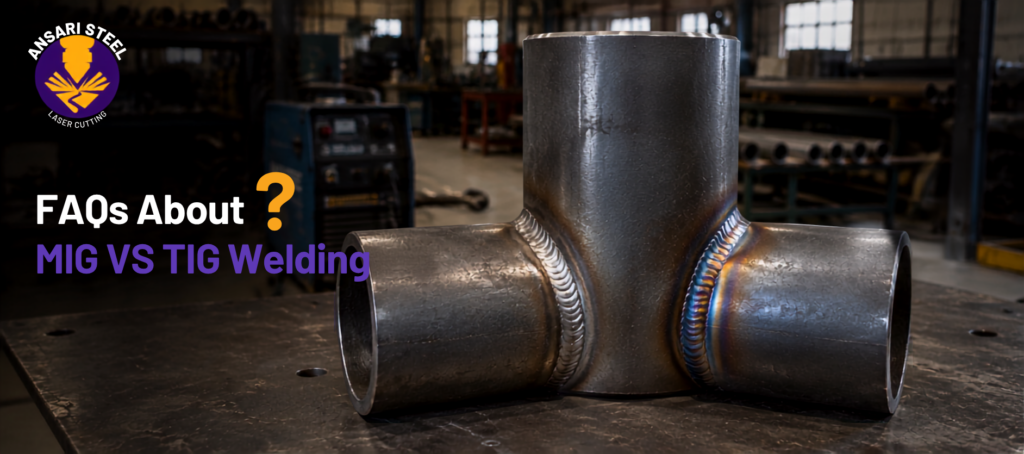
FAQs About MIG VS TIG Welding
The answer depends on your project requirements. MIG vs TIG welding is a common comparison because MIG welding is faster for production, while TIG welding delivers cleaner and more precise welds. Ansari Steel can help you choose the most suitable welding process based on the material and application.
The main Difference Between MIG and TIG Welding is the welding process and finish quality. MIG welding uses a continuously fed wire for faster production, while TIG welding uses a non consumable tungsten electrode to create highly accurate and clean welds.
TIG welding is generally preferred for stainless steel because it produces precise, clean, and visually appealing welds. Ansari Steel recommends selecting the welding method according to the material thickness, strength requirements, and desired finish.
The most widely used types of welding include MIG welding, TIG welding, and ARC welding. Each process is designed for different materials, fabrication requirements, and industrial applications.
ARC welding is commonly used for heavy structural steel, outdoor work, and repair projects where durability is more important than appearance. Ansari Steel can recommend the right welding technique after evaluating your project’s specifications and working conditions.
When performed correctly, MIG, TIG, and ARC welding can all produce strong and reliable joints. The overall strength depends more on proper technique, material preparation, and weld quality than on the welding process itself.
When performed correctly, MIG, TIG, and ARC welding can all produce strong and reliable joints. The overall strength depends more on proper technique, material preparation, and weld quality than on the welding process itself.
Construction, manufacturing, automotive, shipbuilding, engineering, oil and gas, and metal fabrication industries all rely on these welding methods. The choice depends on the application, material, and production requirements.
Yes. Both MIG and TIG welding are widely used for custom fabrication, machinery parts, gates, railings, structural components, and architectural metalwork. The most suitable process depends on the design complexity and finish required.
The best welding method depends on the material type, thickness, production speed, appearance, and budget. Consulting an experienced fabrication company helps ensure the welding process matches your project’s technical and performance requirements.