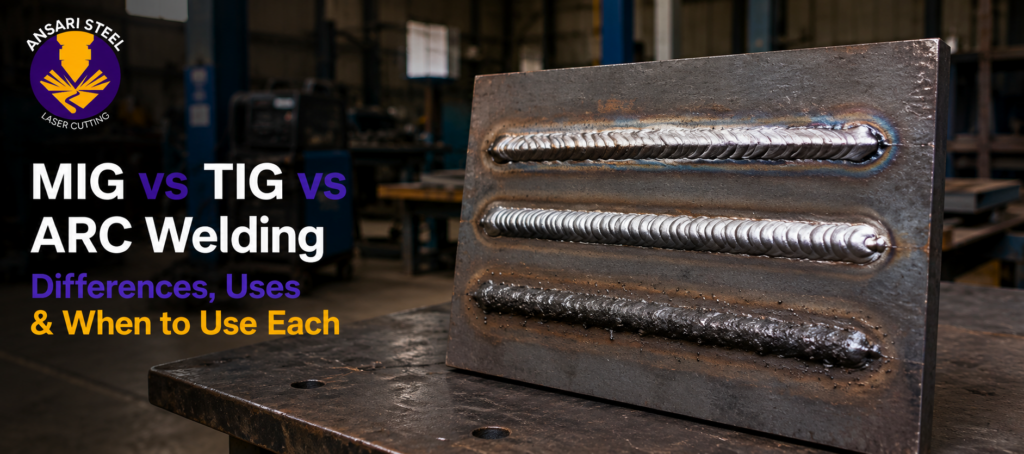
Walk into any fabrication workshop or construction site in Karachi and you will hear the same question repeatedly: Which welding method should we use? The answer is rarely as simple as choosing the most popular process. The right welding technique affects structural strength, production speed, material compatibility, labour costs, and even the appearance of the finished product.
For manufacturers, builders, engineering contractors, and industrial businesses, understanding MIG vs TIG welding is essential before starting a fabrication project. While MIG, TIG, and ARC welding all join metal permanently, each process has its own strengths, limitations, and ideal applications.
Choosing the wrong welding method can increase production costs, create unnecessary rework, or reduce the lifespan of fabricated products. Choosing the right one improves efficiency, delivers stronger welds, and helps projects stay within budget.
Whether you are building steel structures, manufacturing machinery, fabricating architectural metalwork, or repairing heavy equipment, this guide explains the major types of welding, their differences, and how to determine the best welding method for your specific project.
Which Welding Process Is Right for Your Project?
If speed and productivity are your priorities, MIG welding is often the preferred solution. If appearance and precision matter most, TIG welding delivers cleaner and more refined results. When working outdoors or repairing heavy structural steel, ARC welding remains one of the most reliable and economical options.
The correct process depends on your material, project requirements, production volume, and quality expectations.
Why Modern Fabrication Depends on Choosing the Right Welding Method
Welding is the foundation of countless industries across Pakistan. From commercial buildings and industrial warehouses to machinery manufacturing and infrastructure development, welded steel components provide the strength required to support demanding applications.
However, modern fabrication is no longer about simply joining two pieces of metal together. Today’s projects require precise engineering, consistent quality, and manufacturing processes capable of meeting increasingly strict performance standards.
This is why understanding the Difference Between MIG and TIG Welding has become important for engineers, contractors, manufacturers, and business owners alike.
Discover Professional Welding Solutions with Ansari steel
As fabrication projects become more complex, professional guidance plays an increasingly important role in selecting the correct welding process.
Experienced fabrication companies evaluate factors such as metal type, joint design, production volume, required strength, and finishing expectations before recommending a welding technique.
Manufacturers such as Ansari steel understand that no single process is ideal for every application. Selecting the correct method from the beginning improves efficiency while reducing unnecessary manufacturing costs.
What Makes MIG Welding So Popular?
MIG stands for Metal Inert Gas welding. The process uses a continuously fed wire electrode combined with shielding gas to produce a strong weld while maintaining high production speed.
Because the wire feeds automatically, operators can weld continuously without frequently changing electrodes. This makes MIG welding particularly suitable for production environments where efficiency is essential.
Manufacturers commonly choose MIG welding for structural steel fabrication, machinery manufacturing, storage systems, gates, railings, truck bodies, industrial equipment, and general fabrication.
Its combination of speed, strength, and relatively simple operation has made MIG one of the most widely used industrial welding processes.
Advantages of MIG Welding
MIG welding offers several practical benefits.
- High production speed
- Strong structural welds
- Easy to learn compared with other methods
- Suitable for automated manufacturing
- Excellent productivity for medium and large fabrication projects
Although highly versatile, MIG welding generally performs best in controlled workshop environments where shielding gas is protected from wind.
When Is TIG Welding the Better Choice?
Precision Fabrication from Ansari steel
TIG welding, or Tungsten Inert Gas welding, is designed for projects where appearance, precision, and weld quality are more important than production speed.
Unlike MIG welding, TIG uses a non consumable tungsten electrode while filler material is added manually when required. This gives the welder exceptional control over heat input and weld appearance.
Professional fabricators frequently use TIG welding when manufacturing products that require smooth, visually attractive welds or when working with thinner materials that demand greater precision.
Businesses working with Ansari steel often select TIG welding for architectural fabrication, stainless steel products, food processing equipment, pharmaceutical applications, aluminium fabrication, and decorative metalwork.
Although TIG welding is slower than MIG welding, it produces cleaner welds with minimal spatter and excellent cosmetic quality.
Advantages of TIG Welding
The biggest strengths of TIG welding include:
- Superior weld appearance
- Exceptional precision
- Excellent control over heat
- Ideal for stainless steel and aluminium
- Minimal post weld cleaning
These advantages make TIG welding particularly valuable where product appearance is as important as structural performance.
Why ARC Welding Still Plays an Important Role
Despite the popularity of MIG and TIG, ARC welding remains one of the most dependable welding methods used across construction sites and industrial maintenance projects.
Unlike gas shielded processes, ARC welding uses a consumable coated electrode that generates its own shielding gases during welding. This makes it especially effective in outdoor environments where wind could disrupt shielding gas used in MIG or TIG welding.
Construction contractors, maintenance teams, agricultural equipment manufacturers, and infrastructure projects continue relying on ARC welding because of its portability, simplicity, and dependable performance.
Where ARC Welding Performs Best
ARC welding is commonly used for:
Heavy structural fabrication
Construction projects
Steel bridges
Industrial maintenance
Equipment repair
Outdoor fabrication
Large steel assemblies
Although ARC welding generally produces rougher welds than TIG, its versatility and low equipment costs continue to make it one of the most widely used welding methods worldwide.
Comparing the Three Welding Methods Side by Side
Instead of asking which welding process is universally better, the more practical question is which method best suits your project.
MIG welding offers outstanding production speed and strong welds for general fabrication.
TIG welding prioritises precision, appearance, and premium quality.
ARC welding provides flexibility and reliability for heavy duty outdoor work and structural repairs.
The correct decision depends entirely on the intended application rather than one process outperforming the others in every situation.
Which Metals Can Be Welded?
Most industrial fabrication projects involve materials such as:
- Mild steel
- Stainless steel
- Aluminium
- Carbon steel
- Galvanized steel
Different welding methods perform better on different materials. Material thickness, joint design, required strength, and finishing expectations all influence the final process selection.
Choose the Right Welding Process with Ansari steel
Selecting a welding method should never be based on equipment availability alone. The right decision comes from understanding the purpose of the finished product, expected service conditions, material characteristics, and production goals.
For example, a decorative stainless steel staircase requires a completely different approach than a heavy structural frame for an industrial warehouse. Likewise, repairing agricultural machinery in the field demands a different welding process than manufacturing precision food processing equipment.
Experienced fabrication companies evaluate all of these factors before recommending a solution. Businesses frequently work with Ansari steel because professional guidance helps reduce production costs while ensuring every welded component delivers the required strength, durability, and finish.
What Affects the Cost of Welding?
Many customers assume one welding process is always cheaper than another, but the reality is more complex. The final cost depends on several technical and commercial factors.
Material Type
Mild steel is generally the most economical material to weld, while stainless steel and aluminium often require greater skill and specialised techniques.
Material Thickness
Thicker materials require more heat, longer welding times, and additional filler material, increasing production costs.
Welding Process
MIG welding is usually the most economical for high volume fabrication because of its speed. TIG welding often costs more due to slower production and greater operator skill. ARC welding remains cost effective for structural work and field repairs.
Project Complexity
Simple welded frames require less labour than complex assemblies involving multiple joints, precision alignment, or decorative finishes.
Surface Finishing
Grinding, polishing, painting, powder coating, or galvanising add value but also influence the overall project price.
Rather than comparing quotations based only on price, customers should compare the complete scope of work, material quality, and workmanship.
How Professional Welding Projects Are Completed
Every successful fabrication project follows a structured workflow designed to achieve consistent quality.
Project Planning
Engineers review technical drawings, dimensions, and structural requirements before selecting the most suitable welding process.
Material Preparation
Metal surfaces are cleaned and accurately prepared to remove contaminants that could weaken the weld.
Fabrication
Components are cut, formed, assembled, and positioned before welding begins to ensure proper alignment.
Welding
Qualified welders perform the selected welding process while maintaining correct heat control and penetration.
Inspection
Completed welds are inspected for appearance, strength, alignment, and dimensional accuracy before finishing operations begin.
Final Finishing
Depending on the application, fabricated products may be painted, powder coated, galvanised, or polished before delivery.
Following a disciplined production process reduces defects and improves long term reliability.
Practical Advice Before Starting Your Welding Project
Planning ahead can prevent costly mistakes later in the project.
Provide accurate engineering drawings whenever possible.
Select materials according to performance rather than initial cost.
Discuss structural loading requirements before fabrication begins.
Confirm delivery timelines in advance.
Choose experienced welders familiar with your industry.
Review the quotation carefully to understand exactly what is included.
These simple steps often save both time and money while improving final quality.
Mistakes That Often Lead to Expensive Repairs
Many welding problems originate during planning rather than fabrication.
Some of the most common mistakes include:
- Choosing a welding process based only on price.
- Using the wrong welding method for the material.
- Ignoring corrosion protection after fabrication.
- Hiring inexperienced welders for structural work.
- Failing to inspect completed welds.
- Making design changes after fabrication has already started.
Avoiding these issues improves project quality and reduces future maintenance.
Why Different Industries Prefer Different Welding Methods
Each industry has unique manufacturing requirements.
Construction companies often rely on ARC welding for heavy structural steel.
Automotive manufacturers commonly use MIG welding because it supports fast production.
Architectural fabricators frequently choose TIG welding to achieve smooth decorative finishes.
Food processing equipment, pharmaceutical manufacturing, and stainless steel fabrication also depend heavily on TIG welding because of its clean appearance and precision.
There is no universal solution. The best welding process is always determined by the project itself.
What Is Changing in the Welding Industry?
Modern fabrication continues to evolve with improvements in welding equipment, digital controls, automation, and quality inspection.
Advanced inverter welding machines now provide greater energy efficiency and improved arc stability.
Automated and robotic welding systems are becoming increasingly common in manufacturing facilities where consistent production quality is essential.
Businesses working with experienced manufacturers such as Ansari steel benefit from modern fabrication practices that improve productivity while maintaining reliable welding quality across large production runs.
Final Thoughts
The comparison between MIG vs TIG welding is not about finding a single winner. Each process has been developed to solve different manufacturing challenges.
MIG welding delivers excellent productivity for fabrication and production work.
TIG welding offers unmatched precision and appearance for premium fabrication.
ARC welding remains dependable for heavy structural applications and outdoor environments.
Understanding the strengths of each process allows engineers, manufacturers, contractors, and business owners to select the most suitable welding method for every project while achieving the best balance of quality, efficiency, and cost.
Talk to Welding Specialists Before You Start
If your project involves structural fabrication, machinery manufacturing, architectural metalwork, or industrial steel construction, discussing your requirements with experienced professionals is the best way to ensure the right welding process is selected.
A technical consultation helps determine suitable materials, production methods, project timelines, and finishing options, ensuring the final product meets both engineering requirements and budget expectations.