
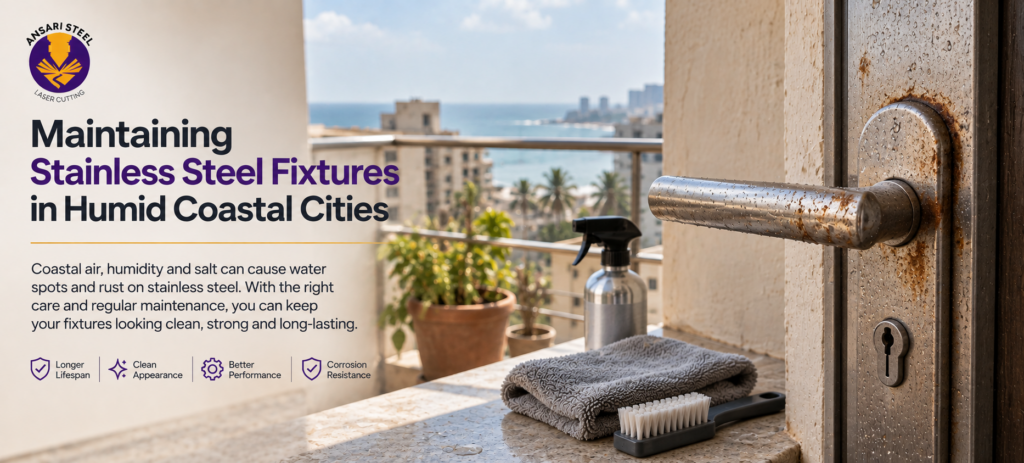
Stainless steel is widely chosen for doors, railings, counters, kitchen equipment, window sills, handrails, cabinets, commercial fittings, and industrial fixtures because it offers a clean appearance and strong resistance to corrosion. However, stainless steel is not completely maintenance free, especially in humid coastal cities such as Karachi.
Moisture, salt particles, dust, fingerprints, cleaning chemicals, and industrial pollution can gradually affect the surface. What begins as a light stain may develop into brown spotting, dullness, water marks, or surface corrosion when regular cleaning is ignored.
Effective stainless steel maintenance does not require aggressive chemicals or complicated equipment. The best results usually come from correct material selection, gentle cleaning, proper drying, and early treatment of stains before they become difficult to remove.
This guide explains how to clean and maintain stainless steel fixtures in coastal environments, which products to use, what mistakes to avoid, how often professional care may be needed, and how homeowners and businesses can protect their investment for many years.
What Is the Best Way to Maintain Stainless Steel?
Clean the surface regularly using clean water, a mild detergent, and a soft microfiber cloth. Wipe in the direction of the visible grain, rinse away all cleaning residue, and dry the surface completely.
In humid or coastal locations, fixtures exposed to outdoor air should be washed more frequently to remove salt and dust. Avoid steel wool, harsh abrasive powders, strong chlorine cleaners, and dirty tools previously used on mild steel.
Small stains should be treated early. Allowing salt deposits, chemicals, or contaminated water to remain on the surface increases the risk of staining and corrosion.
What This Stainless Steel Care Guide Covers
Why stainless steel can still stain
How coastal air affects metal fixtures
Suitable stainless steel grades
Daily and routine cleaning methods
Removing fingerprints, water marks, and rust spots
Products and tools to avoid
Maintenance for homes and industrial facilities
Professional restoration and polishing
Common maintenance mistakes
Long term care and replacement planning
Why Coastal Humidity Changes the Maintenance Routine
Stainless steel contains chromium, which reacts with oxygen to form a thin protective layer on the surface. This passive layer helps resist ordinary rusting and can naturally reform when the surface is clean and exposed to oxygen.
In a humid coastal environment, salt particles settle on the metal and attract moisture. Dust, grease, and pollution can trap this moisture against the surface. If deposits remain for long periods, they can weaken local protection and create tea staining or small corrosion spots.
Karachi’s climate can be particularly demanding for outdoor railings, gates, entrance fittings, rooftop fixtures, balconies, commercial kitchens, and industrial equipment. Properties closer to the sea usually require more frequent cleaning than inland locations.
The maintenance schedule should therefore reflect the actual exposure rather than following one routine for every building.
Stainless Steel Care Planning with Ansari steel
A maintenance plan begins with identifying the stainless steel grade, surface finish, location, and level of exposure.
Ansari steel can assess whether a fixture is installed indoors, outdoors, near the coast, in a kitchen, inside a factory, or in an area exposed to chemical cleaning. These conditions affect how often the surface should be cleaned and which products are appropriate.
Brushed stainless steel, mirror polished fixtures, and industrial surfaces also require different handling. A product that works well on a heavy duty workshop table may leave visible streaks on a decorative mirror finish.
Why Stainless Steel Is Not Completely Stain Proof
The name stainless steel often creates the impression that the material can never rust. In reality, it means the steel is more resistant to corrosion than ordinary carbon steel.
Several conditions can still cause staining:
- Salt deposits
- Chlorine based cleaners
- Iron contamination
- Standing water
- Welding heat marks
- Deep scratches
- Poor drainage
- Industrial chemicals
- Incorrect grade selection
Surface contamination from ordinary steel tools is a frequent cause of unexpected rust spots. When iron particles become embedded in stainless steel, they can corrode and create the appearance that the stainless steel itself is failing.
Choosing the Right Stainless Steel Grade
Not all stainless steel grades provide the same level of corrosion resistance.
Grade 304
Grade 304 is widely used for indoor fixtures, kitchens, counters, cabinets, doors, railings, and general architectural products. It performs well in many environments when cleaned regularly.
In locations with strong salt exposure, it may develop tea staining if maintenance is neglected.
Grade 316
Grade 316 contains molybdenum, which improves resistance to salt and more aggressive environments. It is often preferred for coastal properties, marine applications, pharmaceutical facilities, food processing equipment, and outdoor architectural fixtures.
It usually costs more than Grade 304, but the added protection can reduce maintenance and improve long term performance in demanding locations.
Other Grades and Finishes
Special grades may be selected for chemical, high temperature, or heavy industrial applications. Surface finish also matters because smoother finishes generally retain less contamination and are easier to clean.
How to Clean Stainless Steel Correctly
For routine cleaning, start with the mildest method. Warm water and a soft cloth are often enough for light dust and fingerprints.
Add a small amount of mild detergent when grease or dirt is present. Wipe gently in the direction of the grain where visible. After cleaning, rinse the surface using clean water and dry it with a separate soft cloth.
Drying is important because water left to evaporate can produce mineral marks, especially where the local water supply contains dissolved salts.
For fixtures with joints, corners, or decorative patterns, use a soft brush to remove trapped dirt without scratching the finish.
Practical Cleaning Advice from Ansari steel
Before applying any cleaner to a large visible area, test it on a small hidden section.
Ansari steel recommends checking the product label carefully and avoiding cleaners containing strong chlorine compounds unless they are specifically approved for stainless steel and used according to professional instructions.
Clean tools should be reserved for stainless steel wherever possible. A brush or pad previously used on rusted mild steel may transfer iron contamination to the stainless surface.
Removing Common Marks and Stains
Fingerprints and Light Grease
Fingerprints can usually be removed with mild detergent and warm water. A stainless steel cleaner may be used on decorative surfaces if it leaves no sticky residue.
Water Marks
Use clean water and a soft cloth, then dry the surface immediately. For persistent mineral deposits, a mild approved acidic cleaner may help, but it must be rinsed away thoroughly.
Tea Staining
Tea staining appears as brown discolouration, often on outdoor stainless steel near the coast. It is usually a surface issue rather than deep structural corrosion.
Use an approved stainless steel cleaner and a soft non scratching pad. Clean in the grain direction, rinse thoroughly, and dry.
Light Surface Rust
Small rust spots may be caused by external iron particles. Use a stainless steel restoration product suitable for the finish. Avoid ordinary steel brushes or harsh grinding tools.
Welding Discolouration
Heat tint around welded areas may reduce local corrosion resistance. Professional mechanical or chemical treatment may be needed to restore the surface properly.
A Simple Stainless Steel Cleaning Routine
A reliable routine can be completed in a few stages.
Remove Loose Dirt
Use clean water or a soft cloth to remove dust, salt, and surface particles.
Wash the Surface
Apply mild detergent using a microfiber cloth or soft sponge. Work with the grain rather than against it.
Rinse Thoroughly
Remove all cleaner and dissolved contamination with clean water.
Dry Completely
Use a clean cloth to prevent water spots and moisture collection.
Inspect the Fixture
Check edges, welds, joints, fasteners, corners, and areas near the floor for staining or damaged surfaces.
Treat Problems Early
Address small marks before they spread or become difficult to remove.
Maintenance Support from Ansari steel
The correct maintenance frequency depends on how quickly contamination builds up.
Ansari steel can recommend practical cleaning intervals based on fixture location and usage. Outdoor coastal fittings may need attention every few weeks, while indoor decorative items may only require routine wiping and occasional detailed cleaning.
Commercial kitchens, hospitals, food facilities, and factories may require documented cleaning schedules because hygiene and process contamination are as important as appearance.
How Often Should Stainless Steel Be Cleaned?
There is no single schedule for every property.
Indoor fixtures in dry, low traffic locations may only need periodic cleaning. High touch surfaces such as door handles, lift panels, counters, and railings should be cleaned more frequently.
Outdoor coastal fixtures require regular washing to remove salt deposits. After strong winds, rain, construction work, or nearby industrial activity, additional cleaning may be necessary.
A useful schedule may include:
- Daily cleaning for food contact surfaces
- Weekly cleaning for high touch commercial fixtures
- Monthly cleaning for protected outdoor fittings
- More frequent washing for direct coastal exposure
- Immediate cleaning after chemical spills
Inspection frequency should increase where failures could affect safety or hygiene.
Products and Tools You Should Avoid
Incorrect cleaning methods can damage the protective surface or create visible scratches.
Avoid:
- Steel wool
- Carbon steel wire brushes
- Harsh abrasive powders
- Dirty workshop rags
- Strong chlorine bleach
- Hydrochloric acid
- Unapproved drain cleaners
- Sandpaper on decorative finishes
- Tools contaminated with ordinary steel
- Cleaners left to dry on the surface
If a stronger chemical treatment is required, follow professional guidance and all safety instructions.
Stainless Steel Compared with Coated Mild Steel
Feature | Stainless Steel | Coated Mild Steel |
Corrosion Resistance | High with suitable grade | Depends on coating condition |
Routine Maintenance | Cleaning and inspection | Cleaning plus coating repairs |
Scratch Response | Surface may remain protected | Damage may expose bare steel |
Appearance | Natural metal finish | Painted or powder coated |
Coastal Performance | Strong with correct grade | Requires careful protection |
Initial Cost | Higher | Usually lower |
Stainless steel often provides better long term value in humid, hygienic, or highly visible applications, but it still requires suitable grade selection and regular care.
Maintaining Different Types of Fixtures
Doors and Frames
Clean the lower frame, threshold, hinges, lock areas, and edges where moisture collects. Ensure floor washing water does not remain against the frame.
Railings and Handrails
High touch railings collect oils and fingerprints. Outdoor railings also collect salt and dust, particularly on horizontal tubes and welded joints.
Kitchen Counters and Equipment
Remove food, oil, and chemical residue quickly. Use food safe cleaning products where required and dry surfaces after washing.
Window and Door Sills
Sills collect dust, rainwater, and cleaning residue. Keep drainage paths open and inspect corners for staining.
Industrial Cabinets and Enclosures
Check around fasteners, hinges, ventilation slots, and areas exposed to process chemicals. Confirm that cleaning products do not damage electrical seals or labels.
Common Stainless Steel Maintenance Mistakes
One common mistake is waiting until visible rust appears before starting maintenance. By that stage, staining may require stronger treatment or professional restoration.
Other mistakes include:
- Using bleach repeatedly
- Cleaning against the grain
- Allowing salty water to dry naturally
- Using the same tools on mild and stainless steel
- Ignoring hidden joints
- Selecting Grade 304 for severe exposure without a care plan
- Leaving protective film on outdoor fixtures too long
- Failing to rinse cleaning chemicals
- Scrubbing mirror finishes with abrasive pads
- Assuming polished steel never needs cleaning
Good stainless steel maintenance is based on prevention rather than occasional aggressive cleaning.
A Coastal Karachi Example
A seaside apartment installs brushed stainless steel balcony railings. During the first year, the railings are rarely washed because the owner assumes rain will keep them clean.
Over time, brown tea staining develops on the horizontal sections. Rainwater alone has not removed the salt. Instead, moisture has combined with deposited salt and dust.
A regular fresh water wash, careful drying, and early treatment of stains could have maintained the original appearance with much less effort.
This example shows why coastal cleaning must remove contamination rather than simply wetting the surface.
When Professional Restoration Is Needed
Professional treatment may be necessary when fixtures have widespread staining, deep scratches, welding discolouration, chemical damage, uneven polishing, or corrosion around joints.
Restoration can involve specialised cleaning, mechanical polishing, passivation, surface refinishing, weld repair, or replacement of damaged components.
Decorative finishes require particular care because an incorrect repair can create patches that look different from the surrounding surface.
Ansari steel can assess whether cleaning is sufficient or whether the fixture requires professional refinishing or fabrication repair.
What Does Stainless Steel Maintenance Cost?
Routine cleaning is relatively inexpensive compared with restoration or replacement. Cost increases when access is difficult, staining is severe, specialised chemicals are required, or the original finish must be recreated.
Major pricing factors include:
- Total surface area
- Stainless steel grade
- Finish type
- Level of contamination
- Accessibility
- Height and safety equipment
- Chemical treatment
- Polishing requirements
- Fabrication repairs
- Replacement hardware
- Project location
A planned maintenance programme generally costs less than emergency restoration after years of neglect.
Future Trends in Stainless Steel Care
Building owners and industrial facilities are increasingly choosing materials based on lifecycle performance rather than initial price alone.
Grade selection is improving, and architects are using smoother finishes that are easier to clean. Fabricators are paying more attention to weld treatment, drainage, hidden surfaces, and contamination control.
Low residue cleaners, improved passivation systems, and documented maintenance programmes are also becoming more common in food, healthcare, hospitality, and industrial environments.
The strongest trend is designing fixtures for easier care. Products with accessible joints, good drainage, fewer dirt traps, and suitable finishes remain cleaner and last longer.
Final Thoughts
Effective stainless steel maintenance in humid coastal cities requires regular cleaning, fresh water rinsing, complete drying, and early treatment of stains.
Choose the right grade for the environment, avoid chlorine based cleaners and contaminated tools, inspect welds and joints, and increase cleaning frequency where salt and humidity are high.
Stainless steel offers excellent durability and appearance, but its performance depends on informed care. Small routine actions can prevent expensive restoration and preserve fixtures for many years.
Plan Your Stainless Steel Care with US
Share photographs, fixture locations, stainless steel grades, finishes, current stains, and exposure conditions before requesting professional advice or pricing.
Ansari steel can recommend suitable cleaning, polishing, passivation, repair, or replacement options. A practical maintenance plan with Ansari steel helps protect appearance, reduce corrosion risk, and extend the service life of stainless steel fixtures in Karachi’s demanding coastal climate.
FAQs About Stainless Steel Maintenance
Regular stainless steel maintenance includes cleaning the surface, removing salt deposits, and applying suitable protective products when needed. Ansari Steel recommends routine care to preserve the finish and reduce the risk of corrosion in coastal environments.
How to Maintain Stainless Steel starts with using a soft cloth, warm water, and a mild detergent to remove dirt and fingerprints. Avoid abrasive pads or harsh chemicals that can scratch or dull the surface.
Stainless steel fixtures in coastal cities should be cleaned more frequently because humidity and airborne salt can build up on the surface. Ansari Steel recommends regular cleaning schedules to help maintain appearance and long term durability.
The most effective Stainless Steel Cleaning Tips include wiping surfaces with a soft microfiber cloth, cleaning with mild soap, rinsing thoroughly, and drying completely to prevent water spots and residue.
How to Clean Stainless Steel with light staining involves using a non abrasive stainless steel cleaner and gently wiping in the direction of the grain. Ansari Steel recommends treating stains early to maintain the original finish and prevent further damage.
Yes. Although stainless steel is highly corrosion resistant, prolonged exposure to moisture, salt, and pollutants can cause surface staining or tea staining if the material is not cleaned and maintained regularly.
Grades such as 316 stainless steel generally provide better resistance to corrosion in coastal environments than standard grades. The most suitable grade depends on the installation location and exposure to salt and moisture.
Avoid steel wool, abrasive scrubbers, bleach, and strong acidic cleaners because they can damage the protective surface layer. Gentle cleaning products designed for stainless steel are the safest choice.
Yes. Routine cleaning, proper care, and prompt removal of contaminants help preserve the protective surface and extend the service life of stainless steel fixtures in homes and commercial buildings.
A good Stainless Steel Care Guide should include regular cleaning schedules, suitable cleaning products, inspection for stains, immediate removal of contaminants, and proper drying after washing. Following these practices helps keep stainless steel looking attractive and performing well for many years.