Choosing the right metal cutting service can make a significant difference in the quality, accuracy, and cost of any fabrication project. Whether you are manufacturing industrial components, constructing commercial buildings, producing custom machinery, or creating architectural metalwork, precision is essential. This is where CNC laser cutting in Karachi has become one of the most trusted solutions for businesses seeking consistent, high quality metal processing.
With rapid industrial growth across Karachi and Pakistan, manufacturers, engineering companies, construction contractors, and fabrication workshops increasingly rely on CNC laser technology to produce clean cuts, reduce production waste, and improve overall efficiency. Unlike conventional cutting methods that often require extensive finishing work, laser cutting delivers smooth edges and remarkable dimensional accuracy while reducing production time.
However, many customers still have common questions before placing an order. What materials can be cut? How much does laser cutting cost? Which factors influence pricing? How accurate is the process? How do you choose a reliable service provider? Understanding these aspects helps businesses make informed decisions and avoid costly mistakes.
This comprehensive guide explains everything you need to know about CNC laser cutting in Karachi, including how the process works, available materials, pricing considerations, benefits, and what to expect before selecting a professional fabrication company.
What Is CNC Laser Cutting and Why Is It Popular?
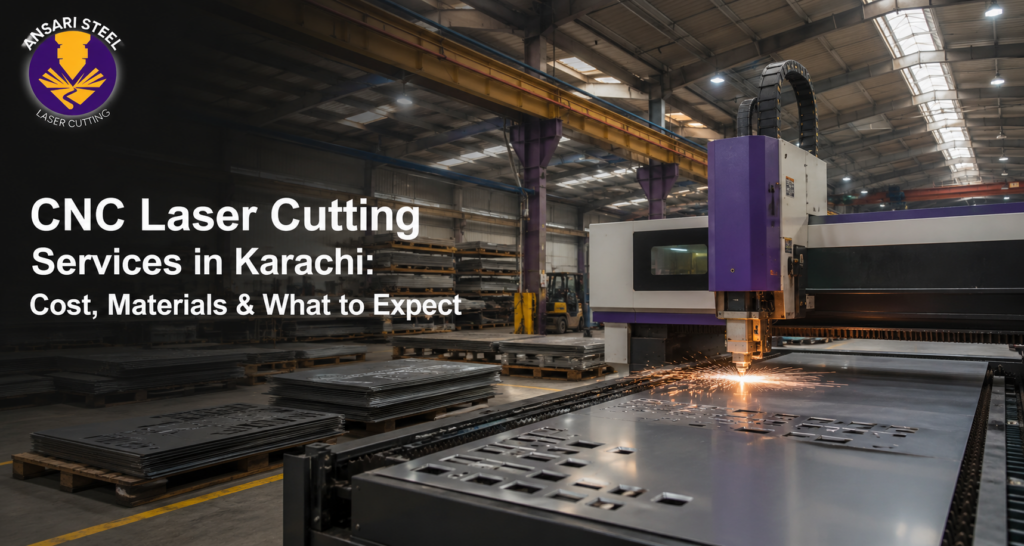
CNC laser cutting is a computer controlled manufacturing process that uses a highly focused laser beam to cut, engrave, or shape metal sheets and other industrial materials with exceptional precision. The CNC system follows digital design files, allowing the machine to produce highly accurate cuts repeatedly without manual intervention.
Compared with traditional cutting methods, laser cutting offers greater flexibility, faster production, and cleaner results, making it suitable for both small custom projects and high volume industrial manufacturing.
Businesses searching for laser cutting services Karachi typically choose this technology because it combines speed, precision, and cost effectiveness while supporting a wide range of industrial applications.
Understanding CNC Laser Cutting Technology at Ansari Steel
Computer Numerical Control, commonly known as CNC, refers to automated machines controlled through digital programming. Instead of relying on manual operation, CNC equipment follows precise instructions generated from CAD drawings or engineering designs.
At Ansari Steel, laser cutting uses a concentrated beam of light that generates enough energy to melt or vaporize metal exactly along the programmed path. An assist gas such as oxygen, nitrogen, or compressed air removes molten material from the cutting area, resulting in smooth and accurate edges.
The entire operation is controlled electronically, allowing identical parts to be produced repeatedly with exceptional consistency.
Modern CNC laser machines can process highly detailed designs, complex curves, intricate patterns, and extremely small tolerances that would be difficult or impossible using conventional fabrication methods.
This combination of automation and precision has transformed manufacturing across industries ranging from automotive production to heavy engineering.
Traditional cutting methods often rely on mechanical blades, drilling, punching, or abrasive wheels. While these methods remain useful in certain situations, they can introduce challenges such as rough edges, excessive material waste, slower production speeds, and inconsistent accuracy.
Laser cutting eliminates direct physical contact between the tool and the workpiece. Since the laser beam performs the cutting without mechanical force, there is less distortion, fewer burrs, and minimal damage to surrounding material.
This enables Ansari Steel to achieve cleaner finishes while reducing post processing and finishing costs.
The Evolution of Laser Cutting in Modern Manufacturing
Laser cutting technology has advanced significantly over the past few decades. Early industrial laser systems were primarily used for specialized aerospace and defense applications due to their high cost and limited accessibility.
Today, advances in CNC automation, fiber laser technology, and digital manufacturing have made laser cutting more affordable and widely available across numerous industries.
Manufacturing companies in Karachi have increasingly invested in modern CNC equipment to meet growing demand from sectors including construction, infrastructure, automotive, electrical engineering, interior design, agriculture, and industrial machinery.
Improved machine efficiency has also reduced production costs, making precision laser cutting accessible to businesses of all sizes.
As industries continue embracing automation, laser cutting has become a fundamental part of modern fabrication processes.
Why CNC Laser Cutting Has Become Essential for Businesses
Industrial competition today demands products that are manufactured quickly without sacrificing quality. Customers expect consistent dimensions, reliable performance, and professional finishing while businesses seek methods that improve productivity and reduce waste.
This is why CNC laser cutting in Karachi continues to gain popularity among manufacturers and fabrication companies.
Accurate cutting minimizes assembly issues during production.
Cleaner edges reduce grinding and finishing work.
Faster processing shortens project timelines.
Lower material waste helps reduce production costs.
Digital programming ensures repeatable quality across large production runs.
Businesses involved in sheet metal fabrication, machine manufacturing, commercial construction, electrical panel production, HVAC systems, and custom engineering all benefit from laser cutting technology because it improves efficiency throughout the manufacturing process.
Growing infrastructure projects throughout Karachi have also increased demand for precision fabricated metal components that meet strict engineering specifications.
Important Concepts Every Customer Should Understand
Selecting the right fabrication partner becomes easier when customers understand the factors influencing laser cutting quality.
Material Thickness
Different laser machines are designed to process varying metal thicknesses. Thicker materials require higher laser power and slower cutting speeds to maintain edge quality.
Cutting Accuracy
Precision is measured in extremely small tolerances. High quality CNC systems consistently produce components that match engineering drawings with remarkable accuracy.
Kerf Width
Kerf refers to the width of material removed during cutting. Narrow kerf widths allow manufacturers to maximize material utilization while producing intricate designs.
Heat Affected Zone
Because laser cutting concentrates heat into a very small area, surrounding material experiences minimal thermal distortion compared to conventional cutting methods.
Digital Design Compatibility
Laser cutting machines operate using CAD and CAM files that define exact cutting paths. Well prepared digital drawings improve manufacturing efficiency while reducing production errors.
Why Precision Matters More Than Ever
Modern engineering projects often involve hundreds or thousands of individual components that must fit together perfectly during assembly.
Even small dimensional errors can create installation problems, production delays, increased labor costs, and unnecessary material waste.
Professional fabrication companies therefore invest heavily in advanced CNC systems capable of maintaining consistent accuracy throughout every production batch.
For businesses requiring repeat manufacturing, laser cutting provides dependable consistency that manual fabrication methods struggle to achieve.
This reliability becomes especially valuable for exporters, industrial manufacturers, and engineering contractors working with strict quality standards.
Features That Make Modern CNC Laser Cutting Highly Effective
Today’s laser cutting systems combine powerful hardware with intelligent software to produce outstanding manufacturing results.
Some of the most important capabilities include:
High speed automated production
Excellent dimensional accuracy
Smooth and clean cut edges
Ability to create intricate shapes
Minimal material wastage
Reduced manual labor
Excellent repeatability
Support for custom production
Compatibility with CAD designs
Fast setup for production runs
Many fabrication companies now integrate laser cutting with CNC bending, welding, machining, and finishing processes to provide complete manufacturing solutions under one roof.
Companies such as Ansari steel combine precision cutting with fabrication expertise, allowing customers to streamline production while maintaining consistent quality across multiple manufacturing stages.
Major Benefits of CNC Laser Cutting for Industrial Projects at Ansari Steel
Businesses continue investing in laser technology because it delivers measurable operational and financial advantages.
Superior Precision
Laser cutting produces extremely accurate components suitable for demanding engineering applications where exact dimensions are essential.
Faster Production
Automated CNC programming significantly reduces manufacturing time compared with conventional cutting methods, allowing projects to move into fabrication and assembly much sooner.
Better Material Utilization
Optimized nesting software arranges components efficiently on metal sheets, helping reduce waste and improve cost efficiency.
Cleaner Finishes
Laser cut edges typically require far less grinding or finishing, reducing labor costs while improving the overall appearance of finished products.
Consistent Quality
Every component produced from the same digital file maintains identical dimensions, making laser cutting ideal for large production batches.
Design Flexibility
Complex geometries, detailed patterns, and custom shapes can be manufactured without expensive tooling changes, allowing greater creativity in engineering and architectural projects.
Lower Overall Manufacturing Costs
Although advanced technology may appear expensive initially, reduced waste, faster production, lower labor requirements, and improved efficiency often result in lower total project costs over time.
Professional providers like Ansari Steel help businesses maximize these benefits by combining experienced engineering support with modern manufacturing capabilities tailored to diverse industrial requirements.
Types of CNC Laser Cutting Services Available
Every manufacturing project has unique requirements, which is why laser cutting services are available in different forms depending on material type, production volume, and application. Understanding these options helps customers choose the most suitable solution for their project.
Sheet Metal Laser Cutting
One of the most common applications is sheet metal cutting Karachi businesses rely on for construction, engineering, electrical enclosures, machinery, furniture, and industrial fabrication.
This process delivers highly accurate cuts on flat metal sheets while maintaining smooth edges and tight tolerances.
Custom Component Manufacturing
Many businesses require one off prototypes or custom fabricated parts rather than mass production. CNC laser cutting allows manufacturers to create unique components directly from CAD drawings without investing in expensive tooling.
Production Batch Cutting
Industrial manufacturers often require hundreds or thousands of identical parts. CNC automation makes batch production highly efficient by maintaining consistent quality throughout every production run.
Decorative Metal Cutting
Laser technology is also widely used for architectural screens, decorative panels, signage, gates, railings, and interior design projects where intricate patterns are required.
Industrial Fabrication Support
Many fabrication companies integrate laser cutting into larger manufacturing processes that include bending, welding, machining, powder coating, and assembly.
This reduces production time while ensuring components fit together accurately during fabrication.
Which Materials Can Be Cut Using CNC Laser Technology?
Modern laser cutting systems can process a wide variety of metals commonly used across Pakistan’s industrial sector.
Mild Steel
Mild steel remains one of the most frequently processed materials due to its affordability, strength, and versatility. It is widely used in construction, machinery, industrial equipment, storage systems, and fabrication projects.
Stainless Steel
Stainless steel is preferred where corrosion resistance, hygiene, and durability are essential. Industries such as food processing, pharmaceuticals, hospitals, and commercial kitchens frequently use stainless steel laser cut components.
Aluminium
Aluminium offers an excellent balance of strength and lightweight performance. It is commonly used in transportation, architectural projects, signage, electrical industries, and custom fabrication.
Galvanized Steel
Galvanized sheets provide improved corrosion resistance, making them suitable for HVAC systems, ducting, roofing, electrical cabinets, and outdoor equipment.
Brass and Copper
Laser cutting also supports decorative metalwork and electrical applications requiring precise cuts in brass or copper.
Material selection depends on the intended application, required strength, corrosion resistance, appearance, and budget.
How Does the CNC Laser Cutting Process Work?
Although laser cutting appears simple from the outside, the manufacturing workflow involves several carefully controlled stages designed to ensure consistent quality and precision.
The process begins long before the laser machine starts cutting.
Design Preparation
Customers usually provide engineering drawings, CAD files, or technical specifications. These digital files define every dimension, hole, curve, and cutting path required for manufacturing.
If drawings are unavailable, many professional fabrication companies can assist with design preparation before production begins.
Material Selection
The appropriate metal grade, thickness, and sheet size are selected according to project requirements.
Material choice influences durability, cutting speed, finishing requirements, and overall project cost.
Machine Programming
The CAD design is converted into CNC instructions that guide the laser machine during production.
Advanced nesting software arranges components efficiently on the sheet to reduce waste and improve material utilization.
Laser Cutting
The focused laser beam follows the programmed path with exceptional precision while assist gases remove molten material from the cutting area.
The result is a clean, accurate cut requiring minimal finishing.
Quality Inspection
After cutting, components are inspected for dimensional accuracy, edge quality, and compliance with engineering specifications.
Measurements are verified before parts proceed to fabrication or delivery.
Secondary Operations
Depending on customer requirements, additional services may include bending, welding, drilling, tapping, polishing, powder coating, or complete fabrication.
Step by Step Guide Before Placing Your Order
Choosing the right fabrication service becomes much easier when customers prepare their project properly.
Step 1
Define your application and intended use.
Determine whether the parts will be used in construction, machinery, industrial equipment, furniture, or another application.
Step 2
Select the appropriate material.
Choose metal based on strength, corrosion resistance, appearance, and budget.
Step 3
Determine material thickness.
Different applications require different thicknesses to achieve the desired structural performance.
Step 4
Prepare technical drawings.
Providing accurate CAD files helps avoid production delays and manufacturing errors.
Step 5
Specify quantity.
Production volume affects machine setup, manufacturing efficiency, and overall pricing.
Step 6
Discuss finishing requirements.
Inform the supplier if bending, welding, powder coating, painting, or assembly will also be required.
Step 7
Confirm delivery schedule.
Planning realistic production timelines helps prevent unnecessary project delays.
What Information Should You Provide Before Requesting a Quote?
To receive an accurate quotation, customers should provide as much project information as possible.
Useful information includes:
Material type
Material thickness
Overall dimensions
Quantity required
CAD or engineering drawings
Required tolerances
Surface finish requirements
Delivery location
Required completion date
The more complete the information, the more accurate the quotation will be.
This also reduces misunderstandings during production.
Professional Tips for Choosing a Reliable Laser Cutting Company
Not every fabrication company offers the same level of equipment, expertise, or quality control.
Before making a decision, evaluate several important factors.
Look for companies using modern CNC laser equipment rather than outdated machinery.
Review previous industrial projects similar to yours.
Confirm that dimensional inspection procedures are followed.
Ask whether engineering support is available before production.
Ensure the company can meet your required delivery schedule.
Request sample work if quality standards are critical.
Working with experienced manufacturers such as Ansari steel can simplify the entire production process by providing technical guidance from quotation through final delivery.
Best Practices for Achieving Better Results
Customers can significantly improve project outcomes by following a few practical recommendations.
Provide accurate drawings rather than hand sketches whenever possible.
Avoid making frequent design changes after production begins.
Choose the correct material instead of selecting solely on price.
Discuss tolerances early in the project.
Allow realistic manufacturing timelines for large production orders.
Consult engineers when designing highly complex components.
These practices help reduce manufacturing costs while improving final product quality.
Common Mistakes Customers Should Avoid
Many production issues occur because important details are overlooked before manufacturing begins.
Some of the most common mistakes include:
Choosing the cheapest quotation without evaluating quality.
Providing incomplete engineering drawings.
Ignoring material specifications.
Requesting unrealistic delivery deadlines.
Selecting incorrect sheet thickness.
Failing to discuss finishing requirements.
Assuming all laser cutting machines have identical capabilities.
Not verifying production tolerances.
Avoiding these mistakes can save both time and money while ensuring a smoother fabrication process.
Challenges and Practical Limitations
Although CNC laser cutting offers exceptional advantages, it is important to understand that every manufacturing technology has limitations.
Very thick metal sections may require alternative cutting methods depending on machine capacity.
Reflective materials sometimes require specialized fiber laser equipment.
Certain complex fabricated assemblies still require additional welding and machining after cutting.
Highly detailed designs can increase production time.
Material availability may occasionally affect project schedules during periods of high demand.
Understanding these limitations allows customers to plan projects more effectively and choose the most suitable manufacturing process.
Advantages and Disadvantages at a Glance
Advantages
Exceptional precision
Fast production speed
Smooth cut quality
Reduced material waste
Excellent repeatability
Supports complex designs
Lower finishing costs
Suitable for prototype and mass production
Disadvantages
Higher equipment investment compared to traditional cutting
Very thick materials may require other technologies
Requires accurate digital drawings
Some specialty materials need advanced laser systems
Even with these considerations, CNC laser cutting remains one of the most efficient and cost effective manufacturing solutions available for modern industrial fabrication.
CNC Laser Cutting Compared With Other Metal Cutting Methods
Selecting the right cutting technology depends on your project’s material, thickness, precision requirements, production volume, and budget. While laser cutting is one of the most advanced options available today, understanding how it compares with other methods helps businesses make informed decisions.
CNC Laser Cutting Versus Plasma Cutting
Plasma cutting is widely used for thicker steel plates and heavy industrial fabrication. It is generally faster on very thick materials but does not offer the same level of precision as laser cutting.
Laser cutting produces cleaner edges, tighter tolerances, and finer details, making it the preferred choice for components that require high accuracy or minimal finishing.
Plasma cutting remains suitable for structural steel work where speed is more important than extremely fine detail.
CNC Laser Cutting Versus Waterjet Cutting
Waterjet cutting uses high pressure water mixed with abrasive material to cut metals and other materials without generating heat.
This method is beneficial for heat sensitive materials but is generally slower than laser cutting and often involves higher operating costs.
Laser cutting is usually the better option for high volume manufacturing, intricate designs, and projects requiring rapid turnaround.
CNC Laser Cutting Versus Mechanical Cutting
Mechanical cutting methods such as sawing, punching, or shearing remain useful for basic fabrication tasks. However, they often require additional finishing, generate more material waste, and may struggle with complex shapes.
Laser cutting offers greater flexibility by producing detailed geometries directly from digital drawings without custom tooling.
Alternative Metal Cutting Solutions
Although CNC laser cutting in Karachi is suitable for many applications, some projects may benefit from alternative technologies.
Flame cutting is commonly used for extremely thick carbon steel plates.
Waterjet cutting is suitable for materials affected by heat.
CNC routing is often used for nonmetallic materials such as wood, plastic, and composite panels.
Mechanical shearing is appropriate for simple straight cuts in sheet metal.
A professional fabrication company can recommend the most appropriate process based on your project’s technical requirements.
Real World Applications of CNC Laser Cutting
Laser cutting supports a wide variety of industries throughout Karachi and Pakistan.
Construction Industry
Structural brackets, base plates, stair components, façade panels, railings, gates, and architectural elements are commonly produced using CNC laser cutting.
Manufacturing Sector
Industrial machinery manufacturers rely on precision cut components for machine frames, covers, brackets, housings, and production equipment.
Electrical Industry
Electrical control panels, switchgear enclosures, cable trays, and mounting plates require accurate sheet metal fabrication to ensure proper assembly.
Automotive Industry
Vehicle manufacturers and workshops use laser cut parts for brackets, mounting systems, custom components, and restoration projects.
Interior Design
Decorative wall panels, partitions, ceiling features, furniture components, and custom metal artwork are increasingly produced using laser technology.
Agricultural Equipment
Farm machinery manufacturers require durable and accurately cut components capable of performing under demanding operating conditions.
Energy and Infrastructure
Industrial projects involving power generation, renewable energy, oil and gas facilities, and infrastructure development frequently depend on precision fabricated metal parts.
Practical Industry Examples
Consider a construction contractor building a commercial warehouse in Karachi.
The project requires hundreds of identical steel brackets with precise bolt hole alignment. Manual fabrication could introduce inconsistencies, resulting in installation delays.
Using CNC laser cutting allows every bracket to be manufactured with identical dimensions, reducing fitting issues and accelerating installation.
Another example involves an engineering company manufacturing electrical control cabinets.
Accurately positioned cutouts for switches, displays, cable entries, and ventilation openings are essential. Laser cutting ensures each cabinet matches the engineering drawings exactly, simplifying assembly and improving product quality.
Businesses working with experienced providers such as Ansari steel often benefit from coordinated fabrication processes that reduce production delays and improve consistency from design through final manufacturing.
Market Trends and Industry Insights
Pakistan’s industrial sector continues to expand as investment grows across construction, manufacturing, engineering, renewable energy, and infrastructure development.
This growth has increased demand for precision fabrication services capable of meeting international quality standards.
Several industry trends are shaping the future of laser cutting in Karachi.
Greater adoption of automated manufacturing systems.
Increasing use of fiber laser technology for improved productivity.
Growing demand for customized metal fabrication.
Higher expectations for faster project delivery.
Improved integration between CAD design and CNC manufacturing.
More businesses seeking complete fabrication solutions from a single supplier.
As competition increases, companies that invest in advanced manufacturing equipment and skilled engineering teams are better positioned to deliver reliable, cost effective services.
Future of CNC Laser Cutting
Laser cutting technology continues to evolve rapidly.
Future developments are expected to include smarter automation, artificial intelligence assisted production planning, improved nesting software, lower energy consumption, and even greater manufacturing precision.
Digital manufacturing will also become more closely integrated with cloud based production management systems, allowing customers to track projects more efficiently.
For businesses, this means shorter lead times, improved quality control, and more competitive manufacturing costs over the coming years.
Expert Recommendations Before Choosing a Service Provider
Selecting the right fabrication partner is just as important as selecting the right cutting technology.
Before placing an order, consider the following recommendations.
Choose a company with modern CNC equipment.
Review previous industrial projects.
Ask about quality inspection procedures.
Confirm experience with your specific material.
Discuss production timelines before approving the quotation.
Ensure engineering support is available if design modifications become necessary.
Request clear communication throughout the manufacturing process.
Evaluate value rather than selecting purely on the lowest price.
These factors often have a greater impact on project success than minor differences in quotation cost.
Final Thoughts
Precision manufacturing has become essential for businesses operating in today’s competitive industrial environment. Whether you require custom fabricated components, structural steel parts, machinery components, decorative metalwork, or high volume production, laser cutting delivers the accuracy, efficiency, and consistency needed to achieve reliable results.
Understanding the process, selecting suitable materials, preparing accurate technical drawings, and working with an experienced fabrication company can significantly improve both product quality and project efficiency.
As manufacturing continues to evolve across Karachi and Pakistan, businesses that embrace precision fabrication technologies will be better equipped to reduce waste, improve productivity, and meet increasingly demanding quality standards.
Request a Professional Quote for Your Next Project
If your project requires precision metal fabrication, reliable production timelines, and consistent quality, discussing your requirements with an experienced fabrication specialist is the best first step.
Whether you need prototype development, custom sheet metal components, or large scale production, Ansari steel can help evaluate your drawings, recommend suitable materials, and provide practical manufacturing solutions tailored to your project requirements. By combining technical expertise with modern fabrication capabilities, Ansari steel supports businesses across a wide range of industrial sectors with dependable, precision focused services.