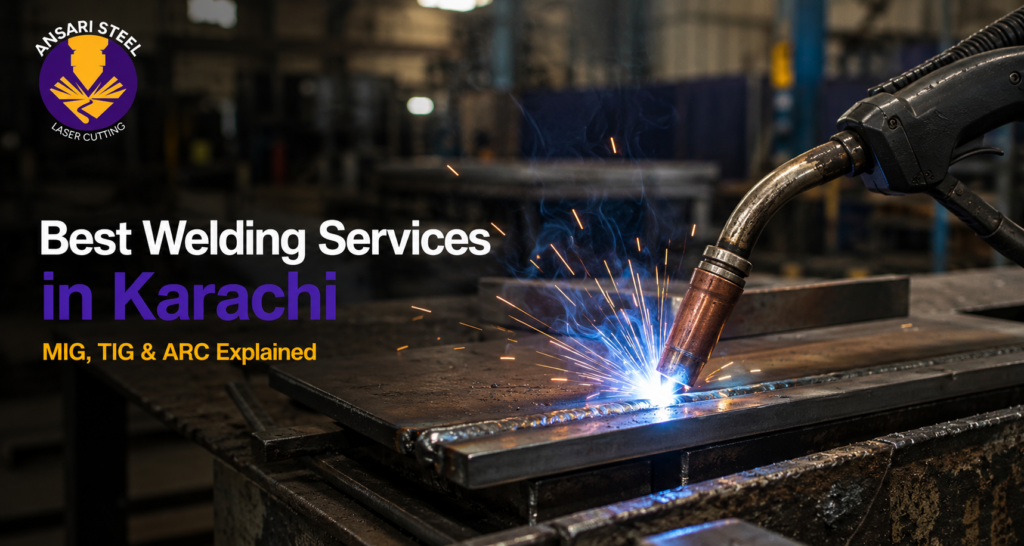
Welding plays a vital role in modern construction, industrial manufacturing, infrastructure development, and metal fabrication. From residential gates and steel staircases to warehouses, factories, pipelines, and heavy machinery, strong and accurate welds ensure safety, durability, and long term performance. This is why businesses and property owners searching for reliable welding services in Karachi need to understand the different welding methods, material options, pricing factors, and how to choose the right contractor.
Karachi is Pakistan’s largest industrial city, with thousands of construction projects, manufacturing facilities, engineering workshops, and fabrication companies operating every day. These industries depend on professional welding services to manufacture, repair, and assemble steel structures that meet demanding quality standards.
Many customers, however, are unsure whether they need MIG, TIG, or ARC welding. They also want to know how much welding costs, which metals can be welded, and how to identify a reliable steel welding contractor capable of delivering consistent workmanship.
This guide explains everything you need to know before selecting a welding service, helping you make informed decisions that save both time and money.
What Should You Know Before Hiring a Welding Company?
Professional welding services in Karachi involve joining two or more metal components using controlled heat and, in many cases, filler material to create a strong and permanent bond. The correct welding process depends on the metal type, project requirements, structural load, finish quality, and working environment.
A reputable welding workshop Karachi businesses trust will evaluate your project, recommend the most suitable welding method, and ensure the finished structure meets engineering and safety requirements.
Understanding Modern Welding Services
Welding is far more than simply joining two pieces of metal together. Modern welding combines skilled craftsmanship with advanced equipment, engineering knowledge, and strict quality control to produce durable structures capable of handling heavy loads and demanding operating conditions.
Professional welding is used in structural steel fabrication, machinery manufacturing, commercial construction, industrial maintenance, pipelines, storage tanks, architectural metalwork, and countless other applications.
Today’s welding workshops also integrate CNC cutting, precision bending, fabrication, and finishing processes to deliver complete manufacturing solutions.
Why Businesses Choose Ansari steel for Professional Welding
As industrial projects become larger and more technically demanding, welding quality has become increasingly important. Poor workmanship can lead to structural weakness, production delays, expensive repairs, and even safety risks.
Experienced fabrication companies understand that every project requires the correct welding process, proper material preparation, and qualified welders capable of producing strong, consistent joints.
Many businesses work with Ansari steel because experienced professionals can recommend the most suitable welding technique based on material type, project specifications, and performance requirements.
How Welding Technology Has Improved
Traditional welding relied heavily on manual skill with limited control over heat, penetration, and weld consistency.
Today’s equipment provides greater precision through improved power sources, better shielding gases, digital controls, and specialized welding processes.
These technological improvements allow manufacturers to produce cleaner welds, stronger joints, reduced distortion, and better productivity while maintaining consistent quality across large production runs.
Modern workshops also use inspection procedures to verify weld integrity before fabricated components leave the workshop.
Understanding MIG, TIG, and ARC Welding
Choosing the correct welding method depends on the application, material, and desired finish.
MIG Welding
MIG welding is one of the most widely used processes in commercial fabrication. It uses a continuously fed wire electrode together with shielding gas to produce strong and efficient welds.
This process is ideal for high production work because it offers fast welding speeds while maintaining excellent strength.
MIG welding is commonly used for structural steel, gates, railings, industrial frames, machinery, and fabrication projects.
TIG Welding
TIG welding produces exceptionally clean and precise welds, making it suitable for projects requiring high quality finishes.
It is commonly used for stainless steel, aluminium, decorative metalwork, food processing equipment, pharmaceutical industries, and architectural applications.
Although TIG welding requires greater operator skill and takes longer than MIG welding, it delivers outstanding appearance and accuracy.
ARC Welding
ARC welding remains one of the most widely used methods for heavy construction and outdoor fabrication.
Its equipment is relatively portable, making it suitable for onsite repairs, infrastructure projects, structural steel erection, and maintenance work.
ARC welding performs well in demanding environments where portability and reliability are important.
Materials Commonly Used in Welding Projects
Different welding methods support different materials depending on project requirements.
The most common materials include:
Mild steel
Stainless steel
Aluminium
Galvanized steel
Carbon steel
Structural steel
Each material requires the correct welding technique, filler material, and preparation method to ensure long lasting performance.
Benefits of Professional Welding Services
Quality Workmanship from Ansari steel
Investing in professional welding provides significant long term advantages for both commercial and industrial projects.
High quality welding improves structural integrity, extends equipment lifespan, reduces maintenance costs, and enhances overall project safety.
Well executed welds also improve the appearance of fabricated products while reducing the likelihood of premature failure.
Professional companies such as Ansari steel focus on precision, proper material preparation, and strict quality control to ensure every welded component performs as intended.
Why Skilled Welders Make a Difference
Even with advanced equipment, successful welding depends heavily on the experience and expertise of the welder.
Qualified professionals understand heat control, joint preparation, welding positions, filler materials, and inspection procedures.
Their knowledge helps prevent common defects such as cracks, incomplete penetration, excessive distortion, and weak weld joints.
Choosing experienced professionals is particularly important for structural fabrication where safety and long term reliability are critical.
What Influences Welding Costs?
The overall cost of a welding project depends on several important factors.
Material type.
Material thickness.
Project complexity.
Welding method.
Labour requirements.
Workshop fabrication or onsite installation.
Quantity of work.
Surface finishing requirements.
Large industrial projects generally require more planning and fabrication time, while small repair jobs can often be completed more quickly.
Understanding these variables helps customers compare quotations more accurately rather than selecting a contractor based solely on price.
Select a Trusted Welding Partner with Ansari steel
Choosing the right welding company is about more than finding the lowest quotation. The quality of materials, welding expertise, inspection procedures, and project management all influence the strength and longevity of the finished product.
Before hiring a contractor, ask about their experience with projects similar to yours, the welding processes they use, and the quality standards they follow. A professional team should also be able to explain why a particular welding method is best suited to your application.
Businesses often work with Ansari steel because experienced fabricators can provide practical recommendations, accurate workmanship, and dependable project delivery from initial consultation through final installation.
How a Professional Welding Project Is Completed
Every successful welding project follows a structured process designed to ensure accuracy, safety, and quality.
Project Assessment
The process begins by reviewing drawings, measurements, material specifications, and structural requirements. This allows the fabrication team to determine the most suitable welding method and estimate production time.
Material Preparation
Metal surfaces are cleaned and prepared before welding begins. Proper preparation removes rust, oil, paint, and contaminants that could weaken the weld.
Cutting and Fabrication
Where necessary, metal components are cut, shaped, drilled, or bent before assembly. Accurate preparation improves fit up and reduces welding defects.
Welding and Assembly
The selected welding process is carried out by qualified welders using appropriate equipment and filler materials. Careful heat control helps produce strong, consistent welds with minimal distortion.
Inspection and Finishing
Completed welds are visually inspected and, where required, tested to ensure they meet project specifications. Grinding, polishing, painting, or protective coatings may then be applied before delivery or installation.
How to Choose the Right Welding Service
Whether your project is residential, commercial, or industrial, selecting the right contractor can significantly affect the final outcome.
Look for companies that have experience with structural steel fabrication and industrial welding.
Ask to see examples of previous work.
Confirm that quality materials are used.
Discuss project timelines before production begins.
Request a detailed quotation that clearly explains the scope of work.
Ensure the company has the capability to handle your project’s size and complexity.
Choosing a reputable steel welding contractor helps reduce delays, improve quality, and provide better long term value.
Best Practices for Better Welding Results
Careful planning before fabrication begins leads to better project outcomes.
Provide accurate drawings whenever possible.
Choose the correct material for the intended application.
Discuss finishing requirements before production starts.
Allow sufficient production time for large projects.
Avoid making design changes after fabrication has begun.
Work with experienced professionals who understand engineering requirements.
These simple practices help reduce manufacturing errors while improving efficiency and overall quality.
Common Mistakes Customers Should Avoid
Many welding problems occur because important details are overlooked during planning.
Some of the most common mistakes include:
Choosing the cheapest quotation without considering workmanship.
Using unsuitable materials for the application.
Ignoring protective coatings for outdoor structures.
Failing to confirm project specifications before fabrication.
Hiring inexperienced welders for structural work.
Not discussing inspection or quality assurance procedures.
Avoiding these mistakes can save considerable time and expense later in the project.
Challenges and Limitations
Although welding is one of the strongest methods of joining metal, every process has practical limitations.
Certain metals require specialised welding techniques.
Improper heat control can cause distortion.
Outdoor welding may be affected by weather conditions.
Complex structural projects require skilled operators and careful quality control.
These challenges highlight the importance of working with experienced fabrication professionals who understand the technical requirements of different welding applications.
Advantages Compared with Other Joining Methods
Welding offers several benefits compared with mechanical fastening or adhesive bonding.
It produces strong permanent joints.
It supports heavy structural loads.
It improves manufacturing efficiency.
It reduces the need for additional fasteners.
It allows complex steel structures to be fabricated accurately.
Mechanical fasteners remain useful where future disassembly is required, but welding is generally preferred for permanent structural applications due to its strength and reliability.
Where Professional Welding Services Are Used
Professional welding supports a wide range of industries throughout Karachi and Pakistan.
Construction companies rely on welded steel structures for commercial buildings.
Manufacturing facilities use welding to build machinery, production equipment, and industrial frameworks.
Warehouses require fabricated storage systems and structural supports.
Engineering companies depend on welded components for infrastructure, transportation, and utility projects.
Residential customers also use welding services for gates, staircases, balconies, boundary walls, and decorative steel work.
Industry Trends and Future Developments
The welding industry continues to evolve with new technologies that improve productivity and quality.
Modern inverter welding machines offer better energy efficiency and control.
Automation and robotic welding are becoming increasingly common in high volume manufacturing.
Improved filler materials and inspection techniques are helping manufacturers produce stronger and more consistent welds.
As industrial development continues across Karachi, demand for skilled welders and precision fabrication services is expected to grow steadily.
Businesses working with established companies such as Ansari steel benefit from modern fabrication techniques, experienced personnel, and manufacturing processes designed to meet current industry expectations.
Final Thoughts
Professional welding is the foundation of countless industrial, commercial, and residential projects. Selecting the correct welding process, using quality materials, and working with experienced professionals ensures stronger structures, improved safety, and better long term performance.
Whether you require heavy structural fabrication, machinery manufacturing, custom metalwork, or repair services, investing in skilled workmanship provides lasting value and dependable results.