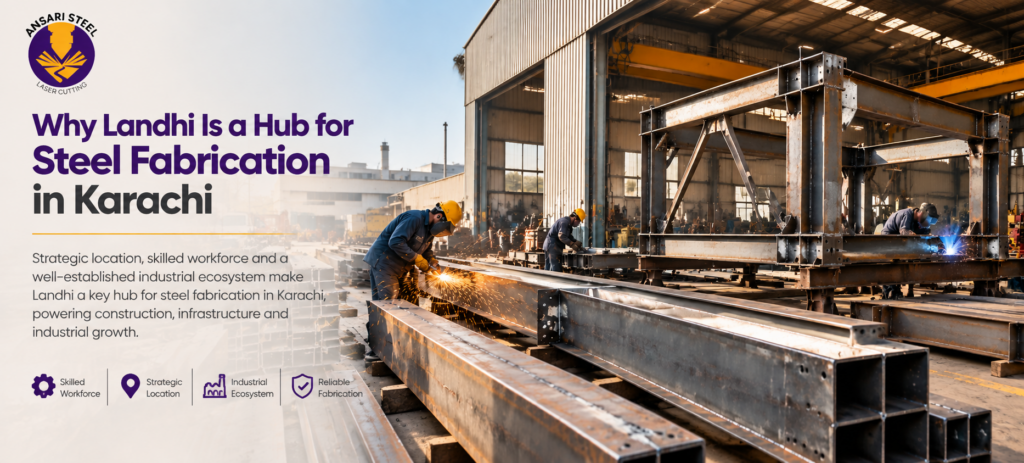
Landhi has developed into one of Karachi’s most important industrial zones, supporting factories, engineering businesses, warehouses, construction suppliers, transport operations, and manufacturing units of different sizes. Its concentration of industrial activity has naturally created strong demand for steel structures, machinery components, platforms, staircases, gates, storage systems, cable trays, and custom fabricated products.
For businesses searching for steel fabrication Landhi, location matters because fabrication projects depend on material availability, workshop capability, transport access, skilled labour, and coordination with other industrial services. Landhi brings many of these requirements together within one established manufacturing area.
The area is not important simply because it contains a large number of workshops. Its real strength comes from the industrial network surrounding those workshops. Steel suppliers, machining facilities, transporters, coating providers, welders, construction contractors, and equipment businesses operate within practical reach of one another. This allows fabrication projects to move from raw material procurement to cutting, welding, finishing, and delivery with fewer logistical interruptions.
This guide explains why Landhi has become a centre for steel fabrication, how the local industry works, which services are available, what affects pricing, and how businesses can choose a capable fabrication partner for residential, commercial, construction, and industrial projects.
Why Do Companies Choose Landhi for Steel Fabrication?
Companies choose Landhi because it offers access to industrial workshops, skilled fabricators, steel markets, transport routes, manufacturing clients, and supporting services within a concentrated commercial zone. This reduces the time required to source materials, coordinate production, and arrange delivery.
Landhi is particularly convenient for factories and businesses operating in Karachi’s eastern and southern industrial areas. A project can often be discussed, measured, fabricated, inspected, and delivered without moving between distant parts of the city.
The area also supports projects of different scales. Small businesses may require a single machine frame or security gate, while larger industrial clients may need complete platforms, structural assemblies, production line supports, or repeated batches of fabricated components.
What This Guide Covers
This guide explains how Landhi developed as a fabrication centre, why industrial location matters, what services local workshops provide, which materials are commonly used, how the production process works, what determines cost, which mistakes customers should avoid, how local fabrication compares with distant suppliers, and what buyers should check before awarding a project.
How Landhi Became an Industrial Fabrication Centre
Landhi’s growth as a fabrication hub is closely connected to its wider industrial development. As factories and processing units expanded, they required reliable suppliers capable of manufacturing and repairing steel equipment without long delays.
A factory cannot always wait for a replacement platform, guard, bracket, or support frame to arrive from another city. Production schedules often depend on quick access to workshops that understand industrial requirements and can respond to urgent maintenance needs.
Over time, local fabricators developed experience in machinery support, structural work, sheet metal products, welding repairs, storage systems, safety barriers, and custom industrial equipment. This practical exposure helped the area build a strong base of skilled workers and workshop knowledge.
The demand was not limited to large factories. Contractors, shop owners, warehouse operators, builders, and residential customers also began using the area for gates, doors, staircases, railings, canopies, and architectural metalwork.
Industrial Experience with Ansari steel
Working in an industrial area provides regular exposure to practical engineering challenges. Projects may involve limited space, existing machinery, strict production schedules, heavy loads, unusual dimensions, or difficult installation conditions.
Ansari steel approaches fabrication by reviewing how the finished product will be used rather than treating every project as a simple cutting and welding job. This helps determine suitable material thickness, support requirements, joint design, finishing, and installation planning.
For industrial clients, this application focused approach can reduce the risk of receiving a product that looks acceptable in the workshop but does not perform properly after installation.
What Services Are Available in Landhi?
Businesses looking for Steel Fabrication Services in Landhi can access a broad range of workshop capabilities. These services may include CNC laser cutting, plasma cutting, sheet metal bending, rolling, drilling, machining, MIG welding, TIG welding, ARC welding, grinding, polishing, painting, powder coating, galvanizing coordination, assembly, transport, and site installation.
Not every workshop offers the same level of equipment or quality control. Some specialise in repair work and general welding, while others are equipped for precision production, structural steel, stainless steel fabrication, or repeated industrial orders.
This variety is useful because buyers can select a provider according to the complexity of the job. A basic gate does not require the same machinery as a precision electrical enclosure or a structural platform designed to support machinery.
Materials Commonly Used in Local Fabrication
Mild steel remains one of the most commonly used materials because it is strong, affordable, widely available, and easy to cut, bend, and weld. It is used for structural frames, gates, platforms, machinery bases, storage racks, and general industrial products.
Stainless steel is selected where corrosion resistance, hygiene, or premium appearance is important. Food processing businesses, pharmaceutical facilities, hospitals, commercial kitchens, and architectural projects often require stainless steel fabrication.
Galvanized steel is widely used for cable trays, HVAC products, electrical cabinets, outdoor components, and structures requiring improved rust protection.
Aluminium is suitable for lightweight panels, signage, equipment covers, and specialised applications. It requires suitable cutting and welding skills because it behaves differently from ordinary steel.
A capable provider of Metal Fabrication Services Landhi should recommend materials according to performance, environment, and lifecycle cost rather than using whichever sheet or section happens to be available.
Why Local Material Access Improves Project Efficiency
Material availability can influence both price and delivery time. Fabricators located near established steel suppliers can compare stock, arrange faster procurement, and respond more quickly when a project requires additional material.
This does not mean every grade or thickness is always available immediately. Special stainless steel grades, uncommon structural sections, or unusually thick plates may still require advance ordering.
However, established industrial relationships help workshops identify suitable suppliers and reduce delays. For repeat customers, common materials may also be planned in advance according to expected production needs.
Ansari steel can review material requirements before production begins so customers receive a more realistic schedule rather than an estimate based on unconfirmed stock.
How a Fabrication Project Moves Through the Workshop
A professional fabrication project normally begins with a drawing, measurement, or clear description of the required product. The workshop reviews dimensions, material type, quantity, load conditions, surface finish, and installation requirements.
Once the design is confirmed, raw material is selected and prepared. Sheets, plates, pipes, and structural sections are then cut according to the approved dimensions.
The components may pass through bending, rolling, drilling, or machining before assembly. Welders position and join the parts while controlling alignment and heat distortion.
After welding, the product is inspected for dimensions, fit, weld quality, and surface condition. Grinding, polishing, painting, powder coating, or another finishing method may then be completed.
The final stage involves delivery or site installation. Large components may require transport planning, lifting equipment, temporary supports, and coordination with the customer’s production or construction team.
Production Coordination with Ansari steel
Good fabrication depends on managing these stages as one connected process. A cutting decision can affect bending, while a welding sequence can influence final alignment. Finishing and transport requirements may also affect how a product should be assembled.
Ansari steel reviews the complete manufacturing sequence before work begins. This helps reduce workshop corrections, material wastage, and site modifications.
For custom projects, early coordination also allows practical design improvements. A bracket may be simplified, a frame may be divided for easier transport, or a connection may be changed from site welding to bolting where appropriate.
Why Custom Fabrication Is Important for Industrial Buyers
Standard products are useful when dimensions and operating conditions are predictable. Industrial facilities, however, often require equipment that fits around existing machinery, columns, pipes, electrical systems, and restricted access areas.
Custom Steel Fabrication Landhi services allow products to be manufactured according to exact site conditions. These may include maintenance platforms, machine guards, tanks, storage systems, supports, stairs, worktables, trolleys, and production line components.
Custom fabrication can also support replacement work. An old component may no longer be available from the original equipment supplier, but a local workshop may be able to measure and reproduce it.
This flexibility is one reason industrial areas continue relying on nearby fabricators even as standard imported products become more widely available.
What Determines the Cost of Steel Fabrication?
Fabrication pricing depends on far more than the weight of steel. Material type and quantity remain important, but design complexity, cutting time, bending operations, welding length, finishing, transport, and installation can significantly affect the final quotation.
A simple welded frame may require less labour than a smaller stainless steel cabinet with multiple bends, polished joints, doors, hinges, and precise openings.
Project urgency also matters. A normal production schedule allows the workshop to organise material and labour efficiently. Urgent jobs may require overtime, interrupted production planning, or faster material procurement.
Buyers should provide complete drawings and specifications before comparing prices. A quotation prepared from limited information may later change when material thickness, finish, or installation requirements are confirmed.
Pricing Clarity from Ansari steel
A clear quotation should explain the material, fabrication processes, finishing, delivery, installation, taxes, and exclusions.
Ansari steel can prepare more accurate pricing when customers provide drawings, dimensions, quantities, application details, and required delivery dates. When information is missing, a technical discussion or site visit may be needed before final pricing.
This approach reduces the risk of unexpected charges and helps customers compare suppliers on the same scope rather than comparing incomplete figures.
Advantages of Choosing a Fabricator Near the Project
A nearby fabricator can inspect the site, confirm measurements, discuss changes, and respond to installation problems more quickly than a distant supplier.
Transport costs may also be lower, particularly for large frames, platforms, gates, and structural components that require special vehicles.
Local support is especially valuable for industrial maintenance. When production equipment requires urgent repair, reducing travel and coordination time can help the facility return to operation sooner.
However, proximity should not replace quality. A nearby workshop without suitable machinery or experience may still create more problems than a capable supplier located slightly farther away.
Challenges Customers Should Consider
Landhi’s large number of fabrication workshops creates choice, but it also creates variation in quality. Some businesses may offer low prices by using thinner material, basic equipment, limited surface preparation, or inexperienced labour.
Customers should not assume every workshop provides the same tolerances, welding quality, finishing, and project management.
Industrial traffic and workshop schedules can also affect delivery times. Large orders require proper planning because material procurement, cutting, welding, finishing, and transport must be coordinated.
Customers should discuss realistic timelines rather than expecting immediate completion for complex projects.
A Practical Example from an Industrial Unit
Consider a factory that needs a maintenance platform around new equipment. The production team requests a quick fabrication based on rough measurements.
A workshop begins work without visiting the site. When the platform arrives, one support conflicts with an existing pipe and the access stair blocks a control panel.
A second project begins with a site survey, coordinated measurements, and a simple approval drawing. The platform is divided into manageable sections and bolted together during installation.
The second approach takes slightly more planning but avoids cutting, welding, and repainting on site. This example shows why local access is most valuable when the fabricator uses it for proper technical coordination.
Common Mistakes Buyers Should Avoid
One common mistake is selecting a workshop only because it provides the lowest quotation. A cheaper price may exclude finishing, installation, transport, or the specified material thickness.
Another mistake is starting production without approved dimensions. Changes after cutting or welding can waste material and delay delivery.
Customers also create problems when they fail to explain the final application. A fabricator cannot select suitable thickness, reinforcement, or coating without knowing whether a product will carry weight, remain outdoors, contact food, or operate near chemicals.
Accepting verbal promises without a written scope is another risk. Material specifications, quantities, finishes, delivery dates, and responsibilities should be recorded clearly.
How to Evaluate Steel Fabricators in Landhi Karachi
Businesses comparing Steel Fabricators in Landhi Karachi should look beyond workshop size and marketing claims. Relevant experience, machinery, operator skill, quality checks, communication, and previous projects provide a better indication of capability.
Ask to see work similar to your requirement. Review weld appearance, dimensional accuracy, bend quality, frame alignment, polishing, and coating.
Confirm which services are completed internally and which are outsourced. Outsourcing is not necessarily a problem, but the main contractor should remain responsible for quality and schedule.
A reliable supplier should ask technical questions before quoting. Immediate pricing without reviewing material, thickness, drawings, quantity, and finish often indicates that important assumptions are being made.
The Future of Fabrication in Landhi
Landhi’s fabrication industry is gradually moving from manual production towards more digitally controlled manufacturing.
CNC cutting, press brake bending, improved welding machines, three dimensional drawings, and digital production planning are helping workshops improve accuracy and repeatability.
Industrial clients are also demanding better documentation, clearer quotations, faster communication, and complete solutions that include fabrication, finishing, delivery, and installation.
The workshops that combine skilled tradespeople with modern equipment and structured quality control will be better positioned to serve future construction and manufacturing demand.
Final Thoughts
Landhi has become a major centre for steel fabrication Landhi projects because of its industrial history, skilled workforce, material access, workshop network, transport connections, and proximity to manufacturing businesses.
The area supports everything from basic welding repairs to precision sheet metal products and large structural assemblies.
Customers should still evaluate each provider carefully. The right workshop should understand drawings, materials, fabrication methods, finishing, delivery, and installation rather than focusing only on cutting and welding.
Plan Your Fabrication Project
Share your drawings, dimensions, material requirements, quantities, finishes, project location, and required completion date before requesting a final quotation.
Ansari steel can review the full manufacturing process and recommend practical options for cutting, bending, welding, coating, delivery, and installation. Early planning with Ansari steel helps create clearer pricing, realistic timelines, and fabricated products that perform correctly after installation.
FAQs About Steel Fabrication Landhi
Landhi is known for its industrial environment, factories, and manufacturing activities, which create high demand for steel fabrication Landhi services. Ansari Steel supports businesses with reliable fabrication solutions designed for industrial and commercial requirements.
Steel Fabrication Services in Landhi include steel cutting, welding, bending, structural fabrication, custom metal work, and installation support. These services are used for construction projects, industrial facilities, warehouses, and commercial buildings.
Look for experience, quality materials, modern fabrication equipment, and a proven project record when selecting Steel Fabricators in Landhi Karachi. Ansari Steel recommends evaluating fabrication quality and technical expertise before choosing a supplier.
Steel fabrication is commonly required for factories, warehouses, commercial buildings, industrial structures, machinery supports, gates, railings, platforms, and construction projects throughout Karachi.
Yes. Custom Steel Fabrication Landhi allows businesses to create steel structures according to specific designs, measurements, and functional requirements. Ansari Steel provides customised fabrication solutions for different industrial and commercial applications.
Common materials include mild steel, stainless steel, galvanized steel, steel plates, and structural steel sections. The selected material depends on project requirements, strength needs, environmental conditions, and budget.
The cost of Metal Fabrication Services Landhi depends on material quantity, design complexity, labour requirements, finishing, and installation needs. A detailed project assessment helps provide a more accurate quotation.
The completion time depends on project size, design complexity, material availability, and production requirements. Small fabrication jobs may be completed quickly, while large industrial projects require detailed planning and longer timelines.
Industries such as manufacturing, construction, engineering, automotive, warehouses, and industrial plants regularly use fabrication services because steel provides strength, durability, and flexibility for different applications.
Before hiring, review the company’s experience, fabrication capabilities, material quality, previous projects, delivery timelines, and customer feedback. Choosing the right fabricator helps ensure better quality, safety, and long term project performance.