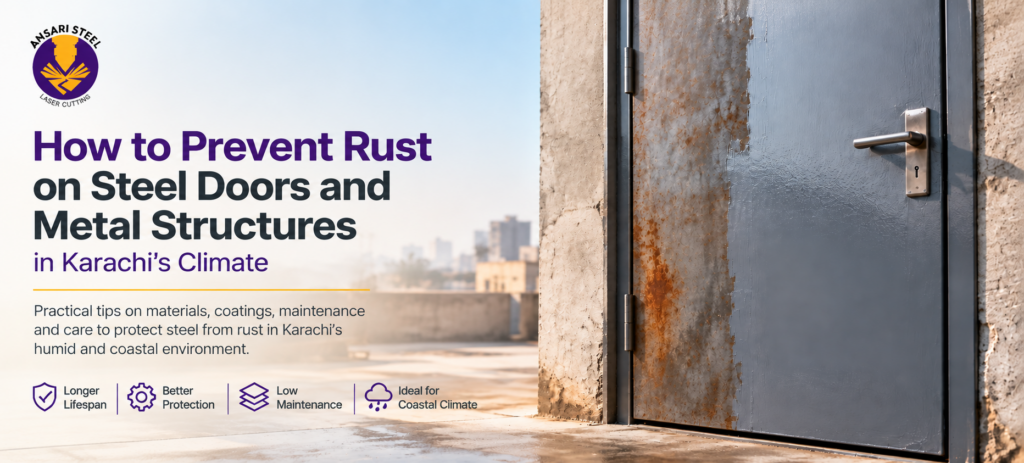
Steel doors, gates, railings, canopies, staircases, warehouse frames, and industrial structures are designed to provide strength for many years. Yet in Karachi, even well fabricated steel can begin showing rust much earlier than expected when it is exposed to humidity, coastal air, rainwater, dust, and damaged paint.
Rust is not only a cosmetic issue. Once corrosion reaches bare steel, it can weaken edges, expand around welds, damage hinges, stain surrounding walls, and increase repair costs. A small scratch on a door may eventually become a larger patch of peeling paint and corroded metal if moisture continues reaching the surface.
The most effective way to prevent rust on steel is to combine correct material selection, careful fabrication, thorough surface preparation, a suitable protective coating, proper installation, and regular maintenance. Painting alone is not enough if rust, oil, welding residue, or moisture remains beneath the coating.
This guide explains why steel rusts faster in Karachi, which prevention methods work best, how coatings are applied, what maintenance is required, and how homeowners, contractors, manufacturers, and industrial businesses can protect their steel investments.
What Is the Fastest Way to Stop Steel from Rusting?
To stop rust effectively, remove all loose corrosion, clean and dry the surface, apply a compatible rust inhibiting primer, and finish it with a durable protective coating suitable for the location.
For outdoor steel, coastal properties, factories, and frequently washed areas, stronger solutions such as galvanizing, epoxy systems, powder coating, or corrosion resistant steel may provide better long term protection than ordinary paint.
Existing rust should never simply be covered. If corrosion remains active beneath the new coating, it will continue spreading and eventually cause bubbling, cracking, and peeling.
Why Steel Rusts Faster in Karachi
Rust forms when iron in steel reacts with oxygen and moisture. Karachi provides several conditions that support this reaction throughout the year.
Humidity keeps exposed steel damp for longer periods. Coastal air may carry salts that speed up corrosion, particularly in neighbourhoods closer to the sea. Dust and pollution collect on horizontal surfaces and hold moisture against the metal. Rainwater can remain trapped around frames, joints, thresholds, and poorly drained sections.
Industrial areas may also expose steel to chemical fumes, oils, washdown water, and airborne contaminants. When these substances settle on a steel surface, they can damage coatings or create conditions where corrosion develops more quickly.
Ansari steel considers the installation environment before recommending a protective system because a coating that performs well indoors may not provide enough protection near the coast or in an industrial plant.
How Rust Usually Starts
Corrosion rarely begins across the entire product at the same time. It usually appears first in vulnerable areas where moisture enters or protective coatings are thin.
Common starting points include:
- Welded joints
- Sharp edges and corners
- Screw and bolt holes
- Hinges and locks
- The bottom of door frames
- Scratched surfaces
- Areas touching wet floors
- Hollow sections with open ends
- Water traps and drainage points
- Damaged coating after installation
Welds require particular attention because heat can affect the surrounding surface, while grinding may remove protective layers. Sharp edges are also difficult to coat evenly because paint tends to pull away from the corner.
Good Steel Rust Prevention begins by identifying these weak points during design and fabrication rather than waiting for damage to appear later.
Rust Protection Planning with Ansari steel
Corrosion protection should be treated as part of the product design, not as a final decorative step.
Ansari steel can review whether a door, gate, railing, platform, or structure will be installed indoors, outdoors, near the coast, in a wet area, or inside an industrial facility. This information affects material choice, drainage, weld finishing, surface preparation, primer, topcoat, and maintenance expectations.
A steel door exposed directly to rain requires more protection than an internal storeroom door. Similarly, an outdoor industrial platform may need galvanizing or an epoxy coating system rather than standard enamel paint.
Design changes can also improve durability. Sealing open sections, avoiding water traps, adding drainage holes, and reducing unnecessary horizontal surfaces can prevent moisture from remaining in contact with steel.
Choose the Right Material Before Fabrication
Mild steel is strong, economical, and easy to fabricate, but it requires reliable surface protection. For many residential and industrial projects, properly prepared and coated mild steel provides excellent value.
Galvanized steel contains a zinc layer that helps protect the underlying metal. It is commonly used for cable trays, roofing components, outdoor frames, electrical products, and other applications exposed to moisture.
Stainless steel provides much stronger natural corrosion resistance and is suitable for coastal, hygienic, chemical, and premium architectural environments. It costs more initially but can reduce maintenance over the product’s lifespan.
Aluminium does not rust in the same way as steel and may be considered for lightweight applications, although it has different structural and fabrication properties.
The right material depends on:
- Exposure to moisture and salt
- Structural load
- Appearance
- Maintenance access
- Product lifespan
- Fabrication requirements
- Available budget
Surface Preparation Determines How Long Paint Lasts
Even the best coating will fail if the steel surface is not prepared properly. Oil, rust, dust, welding scale, and old loose paint prevent primers from bonding securely.
Cleaning and Degreasing
The surface should first be cleaned to remove grease, oil, dirt, and workshop residue. Painting over contamination creates weak areas where the coating may lift.
Rust and Scale Removal
Loose rust, mill scale, and damaged paint should be removed using suitable mechanical or abrasive methods. Wire brushing may be enough for small repairs, while larger industrial products may require blasting or power tools.
Weld Finishing
Sharp weld spatter, rough joints, and uneven grinding should be corrected. Smooth transitions allow primer and topcoat to cover the area more evenly.
Drying
Steel must be dry before coating. Trapped moisture can lead to corrosion underneath the paint film.
For contractors asking How to Prevent Rust on Steel, proper surface preparation is usually the most important answer. Skipping this stage may save time initially but often leads to early coating failure.
Coating and Fabrication Quality from Ansari steel
A protective finish must be compatible from the first layer to the last. Primer, intermediate coat, and topcoat should work as one system rather than being selected independently.
Ansari steel can coordinate fabrication and surface treatment so welds, edges, joints, and hidden areas receive attention before assembly or installation makes them difficult to reach.
For complex structures, some surfaces need to be coated before final assembly. Hollow sections and overlapping plates should also be designed carefully because water can enter gaps that are almost impossible to maintain later.
Which Rust Prevention Method Works Best?
Different projects require different levels of protection.
Rust Inhibiting Primer and Paint
This is a practical option for residential doors, gates, railings, and indoor structures. The surface must be cleaned properly before applying primer and a durable topcoat.
Powder Coating
Powder coating creates a smooth, attractive finish and is widely used for doors, gates, furniture, screens, railings, and architectural metalwork.
It performs best when the steel is prepared correctly and the finished coating is not damaged during transport or installation.
Hot Dip Galvanizing
In this process, fabricated steel is coated with zinc. Galvanizing is commonly used for outdoor structures, towers, supports, cable trays, walkways, and industrial components.
It provides strong protection but may affect final appearance and dimensional details, so the design should consider the process from the beginning.
Epoxy Coating
Epoxy systems offer strong adhesion and resistance in industrial, marine, chemical, and high moisture environments. They are often used with compatible topcoats for greater ultraviolet resistance.
Stainless Steel Construction
For highly corrosive or hygienic applications, stainless steel may eliminate the need for conventional protective paint. However, the correct grade and fabrication methods must still be selected.
Comparing Common Protection Methods
Protection Method | Best Use | Main Benefit | Main Limitation |
Primer and Paint | Homes and general steelwork | Economical and easy to repair | Requires periodic maintenance |
Powder Coating | Doors, gates, panels, railings | Smooth durable appearance | Damage must be repaired quickly |
Galvanizing | Outdoor and industrial structures | Strong long term protection | Higher initial cost |
Epoxy System | Coastal and industrial exposure | Excellent moisture resistance | Requires careful application |
Stainless Steel | Hygienic and corrosive locations | Low maintenance | Higher material cost |
The best method depends on the environment, expected lifespan, appearance, and maintenance plan.
A Step by Step Rust Prevention Process
The following process provides a practical approach for new steelwork.
Review the Environment
Confirm whether the product will be indoors, outdoors, near the coast, frequently washed, or exposed to industrial chemicals.
Select the Material
Choose mild steel, galvanized steel, stainless steel, or another suitable option based on the application.
Improve the Design
Avoid water traps, seal open sections where appropriate, provide drainage, and make maintenance areas accessible.
Complete Fabrication Carefully
Control welding, grinding, edge preparation, and dimensional accuracy. Repair any damaged protective coating after drilling or welding.
Prepare the Surface
Remove grease, rust, scale, spatter, dust, and moisture.
Apply the Protective System
Use the selected primer, coating, galvanizing, powder coating, or specialised treatment according to the manufacturer’s requirements.
Inspect Before Installation
Check coating coverage, edges, corners, welds, holes, and hidden surfaces.
Protect During Transport
Use suitable packaging and handling methods to prevent scratches and impact damage.
Repair Installation Damage
Touch up drilled holes, site welds, cut edges, and scratched areas immediately after installation.
Begin Routine Maintenance
Inspect the product periodically and repair small defects before corrosion spreads.
How to Protect Existing Steel from Rust
Older steel doors and structures can often be repaired if corrosion has not caused serious section loss.
Start by identifying the source of moisture. Repair roof leaks, drainage problems, wet flooring, or open joints before treating the steel.
Remove loose paint and rust until a stable surface is reached. Deep corrosion may require welding repairs, replacement plates, or complete component replacement.
Apply a rust inhibiting primer and compatible topcoat to the cleaned area. The repair should extend beyond the visible rust because corrosion may be spreading underneath nearby paint.
Ansari steel can assess whether a damaged door, gate, or structure only needs surface restoration or whether the steel has weakened enough to require fabrication repairs.
Maintenance Makes the Biggest Long Term Difference
No protective coating lasts forever. Regular inspection allows small problems to be repaired before they become expensive.
Residential doors and gates should be checked before and after the rainy season. Industrial structures may require more frequent inspection depending on exposure.
Look for:
- Scratches and chips
- Paint bubbles
- Orange staining
- Loose fasteners
- Water collecting around frames
- Rust near welds and hinges
- Damaged sealant
- Corrosion beneath hardware
Clean steel surfaces using suitable mild products. Harsh chemicals and abrasive tools can damage finishes.
Lubricate hinges and locks carefully without allowing excessive oil to collect dust around the coating.
Common Rust Prevention Mistakes
One of the biggest mistakes is applying fresh paint directly over rust. This hides the damage temporarily but does not stop corrosion.
Other common mistakes include:
- Using paint without primer
- Coating wet steel
- Ignoring welds and sharp edges
- Leaving open hollow sections
- Allowing water to collect around frames
- Using indoor paint outdoors
- Damaging powder coating during installation
- Delaying scratch repairs
- Mixing incompatible coating products
- Ignoring hidden surfaces
Proper Steel Rust Prevention requires attention to the complete system, not just the visible front surface.
A Karachi Home Example
A homeowner installs a new mild steel main gate with a decorative finish. The gate looks excellent when delivered, but the bottom edge is positioned close to a wet driveway where washing water collects daily.
Within months, paint begins bubbling along the lower section. The problem is not the complete gate. It is continuous moisture exposure combined with a vulnerable edge.
Raising the gate clearance, improving drainage, preparing the damaged steel, and applying a suitable protective system can prevent the same issue from returning.
This example shows that even good fabrication can suffer when installation conditions are ignored.
What Does Rust Prevention Cost?
The cost depends on product size, existing condition, surface preparation, coating type, access, and whether fabrication repairs are required.
Painting a new steel door is generally more economical than restoring a badly corroded structure. Galvanizing, powder coating, stainless steel, and specialised industrial systems may cost more initially but can provide longer service life.
Important pricing factors include:
- Surface area
- Rust severity
- Steel thickness
- Surface preparation method
- Primer and coating system
- Number of coats
- Scaffolding or access equipment
- Transport
- Removal and reinstallation
- Welding repairs
- Project location
Customers should compare total lifecycle value rather than only the first application cost.
When Professional Repair Is Necessary
Minor scratches and small rust spots can often be maintained with careful cleaning and touch up work.
Professional help is advisable when rust has spread across welds, weakened hinges, damaged frames, caused holes, distorted sections, or affected load bearing components.
Industrial structures should be inspected by qualified professionals where corrosion could affect safety.
A responsible contractor should explain whether cleaning and coating are sufficient or whether steel replacement is necessary.
Future Trends in Corrosion Protection
Modern coatings are becoming more durable, environmentally responsible, and suitable for demanding industrial conditions.
Better surface preparation equipment, improved powder systems, zinc rich primers, advanced epoxies, and corrosion resistant alloys are helping steel products last longer.
Digital maintenance records are also becoming more common in industrial facilities. These records allow teams to track coating age, inspection dates, damaged areas, and repair history.
The most valuable trend is preventive maintenance. Businesses increasingly recognise that planned inspections cost less than emergency replacement after corrosion has caused structural damage.
Final Thoughts
The best way to prevent rust on steel is to address corrosion before it starts. Material selection, drainage, fabrication details, surface preparation, coating quality, installation, and maintenance must all work together.
Karachi’s humidity, coastal air, dust, rainfall, and industrial conditions make corrosion protection especially important for steel doors, gates, railings, platforms, warehouses, and structural systems.
Do not wait for large rust patches to appear. Inspect steel regularly, repair scratches quickly, and choose a protection system suited to the actual environment.
Start Your Rust Prevention Project
Share photographs, dimensions, installation location, current steel condition, and exposure details before requesting a recommendation or quotation.
Ansari steel can review whether the project requires cleaning, fabrication repair, primer and paint, powder coating, galvanizing, or a different material. A detailed assessment with Ansari steel helps create clearer pricing and a rust protection plan suited to Karachi’s demanding climate.
The best way to prevent rust on steel is by using high quality protective coatings, regular maintenance, and proper surface preparation before painting. Ansari Steel recommends choosing corrosion resistant finishes that are suitable for Karachi’s humid and coastal environment.
Steel rusts more quickly in Karachi because of high humidity, salty coastal air, and seasonal rainfall. These conditions increase moisture exposure, which speeds up the corrosion process if the steel is left unprotected.
Keeping steel doors and gates clean, repairing damaged paint, and applying protective primers and coatings can significantly reduce corrosion. Ansari Steel also recommends regular inspections to identify and treat small rust spots before they spread.
The most effective Steel Rust Prevention methods include galvanising, powder coating, protective paint systems, and routine maintenance. The right solution depends on where the steel is installed and how much it is exposed to moisture.
How to Protect Steel from Rust outdoors starts with using corrosion resistant coatings, proper drainage, and scheduled maintenance. Ansari Steel recommends selecting high quality finishes designed for Pakistan’s weather conditions to maximise durability.
Yes. Surface rust can often be removed through cleaning, sanding, or blasting before applying a rust inhibitor, primer, and protective coating. Early treatment helps prevent further corrosion and extends the life of the steel.
Steel exposed to outdoor conditions should be inspected at least once or twice a year. Regular inspections help detect small signs of corrosion before they develop into costly repairs.
Yes. Galvanised steel has a protective zinc coating that provides excellent resistance against rust and corrosion. It is commonly used for outdoor structures that require long term durability.
Poor surface preparation, moisture, sunlight, and low quality coatings can cause paint to peel over time. Once the protective layer is damaged, exposed steel becomes more vulnerable to rust.
Consider the installation location, exposure to moisture, maintenance requirements, protective coating type, and expected service life. Choosing the right protection method helps reduce future maintenance costs and improves long term performance.