Choosing a CNC laser cutting provider can look simple until quotations begin arriving with different prices, lead times, material recommendations, and quality promises. One supplier may offer the lowest rate, another may promise faster delivery, while a third may include drawing support, bending, welding, and finishing. The real challenge is understanding which company can produce accurate parts without creating delays, material waste, or costly assembly problems.
A professional CNC laser cutting service should do more than cut a sheet according to a drawing. It should understand material behaviour, machine capacity, tolerances, part nesting, edge quality, and the fabrication work that follows cutting. These details matter whether you need one prototype, a batch of machine components, architectural screens, electrical enclosures, industrial brackets, steel doors, or structural parts.
For manufacturers, engineers, contractors, and small businesses in Karachi, the right supplier can improve product quality and shorten production time. The wrong choice can result in inaccurate holes, rough edges, unsuitable materials, repeated revisions, and unexpected charges.
This guide explains how CNC laser cutting works, what to check before requesting a quotation, how prices are calculated, and how to identify a service provider capable of delivering dependable results.
What Should You Look for in a CNC Laser Cutting Service?
The best provider should have suitable machinery, experienced operators, drawing knowledge, clear quality controls, and proven experience with your material and application. It should review your design before cutting, explain realistic tolerances, and provide a quotation based on material grade, thickness, quantity, cutting complexity, and any additional fabrication work.
Price matters, but the lowest quotation is not always the most economical. Accuracy, material utilisation, delivery reliability, and the amount of finishing required can have a greater impact on your total project cost.
Start with the Part, Not the Machine
Customers often begin by asking which laser machine a workshop uses. That is useful, but the first question should be what the finished component needs to achieve.
A decorative screen requires a different production approach from a load bearing bracket. An electrical enclosure may need precise holes and bends, while a machinery base may require thicker steel and additional welding. The right cutting process depends on the final use, not simply the availability of a machine.
Before contacting a supplier, define the material, thickness, dimensions, quantity, tolerances, finish, and delivery requirements. If the parts will later be bent, welded, machined, or assembled, mention this at the quotation stage because it may affect the drawing and cutting allowances.
Project Planning Support from Ansari steel
Good fabrication begins before production starts. A technical review can identify holes that are too small, corners that need a practical radius, or dimensions that may cause problems during bending and assembly.
Ansari steel reviews project requirements with the complete manufacturing sequence in mind. This approach helps customers avoid designs that look correct on screen but create difficulties during fabrication.
Early planning can also reduce material waste by improving component layout and selecting a sheet size that matches the order quantity.
How CNC Laser Cutting Actually Works
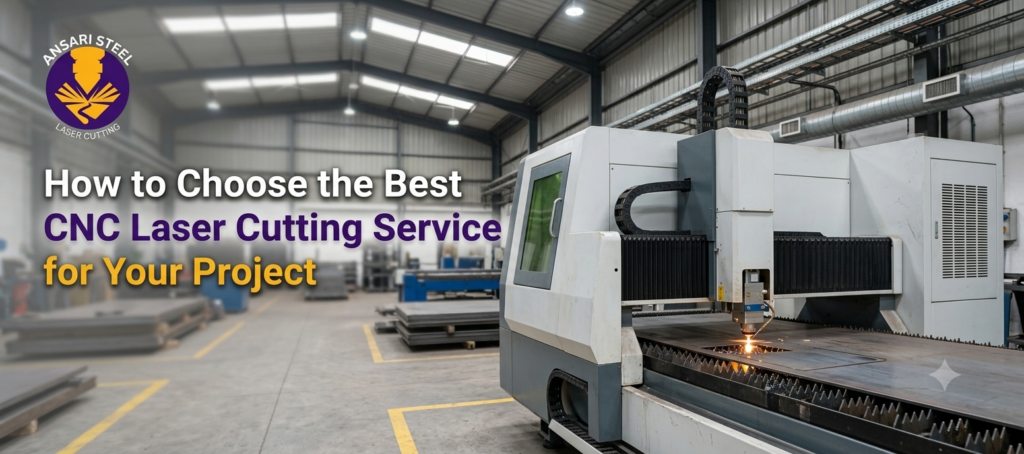
A CNC laser cutting machine follows a digital drawing and directs a concentrated beam along a programmed cutting path. The beam melts or vaporises a narrow line of material while an assist gas removes molten metal from the cut.
Because the cutting head does not physically press against the sheet, the process can create complex shapes with minimal mechanical distortion. Holes, slots, curves, detailed profiles, and repeated components can be produced with strong consistency.
Modern Metal Laser Cutting Services commonly use fibre laser systems for steel, stainless steel, aluminium, galvanized sheet, brass, and copper. Machine power, material type, thickness, and required edge quality determine how quickly and accurately the job can be completed.
Machine Capability Matters More Than Marketing Claims
Two workshops may both advertise laser cutting, but their actual capabilities can differ significantly.
Machine power affects the thickness that can be processed efficiently. Table size determines the maximum sheet dimensions. Cutting head technology influences performance on reflective metals. Software quality affects nesting and material utilisation, while operator experience influences machine settings and final edge quality.
Ask a potential supplier about:
- Maximum material thickness
- Maximum sheet size
- Materials processed regularly
- Machine type and laser power
- Typical dimensional tolerance
- Drawing formats accepted
- Inspection methods
A professional company should answer these questions clearly rather than promising that every material and thickness can be handled equally well.
Evaluate Real Cutting Quality
A cut part should be judged by more than whether the shape looks correct. Edge condition, dimensional accuracy, hole position, heat marks, dross, and flatness all affect the next fabrication stage.
Ansari steel can assess these quality points before components move into bending, welding, machining, or assembly. Consistent inspection is especially important for repeat production because a small error multiplied across hundreds of parts can create major fitting problems.
When reviewing a supplier, ask to see samples made from material and thickness similar to your project. A decorative one millimetre panel does not prove the company can produce an accurate heavy industrial bracket.
Which Materials Can Be Laser Cut?
A capable CNC laser cutting service can process several common engineering metals, although each one requires different settings and expertise.
Mild Steel
Mild steel is widely used for structural components, brackets, machine frames, gates, enclosures, and general fabrication. It cuts efficiently and offers a practical balance of strength, availability, and price.
Stainless Steel
Stainless steel suits food processing, pharmaceutical, hospital, architectural, and coastal applications. It can produce clean premium edges when the correct gas and machine settings are used.
Aluminium
Aluminium is lightweight and corrosion resistant, but it reflects energy and transfers heat quickly. Suitable fibre laser technology and experienced operation are essential for good results.
Galvanized Steel
Galvanized sheets are common in cable trays, HVAC systems, electrical cabinets, and outdoor products. The zinc coating affects fumes and edge behaviour, so appropriate extraction and cutting settings are necessary.
Brass and Copper
Reflective metals such as brass and copper can be processed by suitable fibre laser systems. Confirm the supplier’s experience and machine protection before ordering.
Thickness and Grade Change the Result
It is not enough to tell a supplier that the material is steel. The exact grade, thickness, coating, and surface condition influence cutting speed, gas consumption, edge quality, and price.
Thicker sheets require more power and slower processing. Rust, oil, paint, protective film, or surface distortion may also affect consistency. Some protective films are laser compatible, while others must be removed before production.
Providing the correct specification helps the workshop choose suitable settings and prepare a realistic quotation.
What Makes Custom CNC Laser Cutting Valuable?
Custom CNC Laser Cutting allows parts to be manufactured directly from digital drawings without creating expensive physical tooling for every new design. This makes the process suitable for prototypes, one off products, small batches, and large production runs.
It also allows customers to improve designs without completely changing the manufacturing setup. A hole position, bracket shape, or decorative pattern can often be revised digitally before production.
The main benefits include accurate repetition, complex design capability, reduced material waste, faster production, and cleaner edges than many manual cutting methods.
Prepare Your Drawing Before Requesting a Quote
A clean drawing helps the supplier quote accurately and begin production without unnecessary revisions.
The preferred file types are usually CAD formats such as DXF or DWG. The drawing should be correctly scaled and contain closed cutting paths without duplicate lines. It should also specify material grade, thickness, quantity, and required tolerances.
If only a sketch, PDF, or image is available, ask whether drawing preparation is included. Converting a visual design into a production ready file may require additional time and cost.
For parts that will be bent, include bend lines and final dimensions. For assemblies, provide enough information for the fabricator to understand how the components fit together.
How Laser Cutting Prices Are Calculated
The price of Laser Cutting Services Karachi providers offer depends on several factors rather than a single rate per sheet or kilogram.
Material cost is one major factor, but machine time also matters. A large simple rectangle may cut quickly, while a smaller decorative panel with hundreds of holes and detailed curves can require more time.
Pricing is commonly influenced by:
- Material grade and thickness
- Total cutting length
- Number of piercings
- Design complexity
- Quantity
- Sheet utilisation
- Assist gas
- Drawing preparation
- Deburring or finishing
- Bending, welding, or delivery
Large repeat orders may achieve a lower unit cost because programming and setup are spread across more parts. A properly nested design can also reduce waste and improve the quotation.
Reliable Quotation Review with Ansari steel
A clear quotation should state what is included rather than showing only one final amount. Material supply, cutting, drawing work, finishing, transport, and taxes should be identified where relevant.
Ansari steel can review the order quantity and component layout to improve material usage before production. This is valuable because poor nesting may force the customer to purchase an additional sheet even when the total component area appears to fit.
Customers should also confirm how design changes will be charged after approval. Small revisions before production are usually easier to manage than changes made after sheets have already been cut.
Compare Laser Cutting with Other Cutting Methods
Laser cutting is highly accurate, but it is not the best option for every job.
| Cutting Method | Best Suited For | Main Advantage | Main Limitation |
| Laser Cutting | Detailed sheet metal parts | High accuracy and clean edges | May cost more for very thick plate |
| Plasma Cutting | Thick conductive steel | Fast and economical | Rougher edge and wider kerf |
| Waterjet Cutting | Heat sensitive materials | No heat affected zone | Slower and often more expensive |
| Mechanical Shearing | Straight sheet cuts | Fast for simple work | Cannot create detailed profiles |
A trustworthy provider should recommend an alternative when laser cutting would add cost without improving the result.
Look Beyond Cutting Alone
Many components require additional work after leaving the laser machine. They may need bending, welding, drilling, tapping, grinding, powder coating, painting, polishing, or final assembly.
Choosing a supplier that offers complete fabrication can reduce transport, communication, and scheduling problems between separate workshops. It also makes one team responsible for ensuring the cut parts work correctly in the final product.
However, complete service is valuable only when the provider has proper expertise in each process. Ask which operations are completed internally and which are outsourced.
Common Mistakes Buyers Should Avoid
One common mistake is choosing a provider solely on the lowest quotation. A cheaper cut can become expensive when parts require manual correction, additional grinding, or remanufacturing.
Other avoidable mistakes include:
- Sending incomplete or incorrectly scaled drawings
- Failing to confirm material grade
- Ignoring tolerance requirements
- Choosing unsuitable thickness
- Requesting an unrealistic delivery date
- Approving production without checking a sample
- Forgetting later bending or welding requirements
- Assuming every laser machine has equal capability
A short technical discussion before placing the order can prevent most of these problems.
A Practical Example from a Karachi Workshop
Consider a machinery manufacturer ordering two hundred steel mounting plates. The first supplier provides the lowest cutting price but produces inconsistent hole positions. During assembly, workers must enlarge several holes manually, slowing production and weakening the professional finish.
A second provider charges slightly more but checks the CAD file, confirms tolerances, and produces a sample before the full batch. Every plate fits correctly, assembly moves faster, and no material is rejected.
The second quotation creates better overall value even though the cutting rate is higher. This is why industrial buyers should compare total project efficiency rather than machine time alone.
How to Assess CNC Laser Cutting Services Karachi Buyers Can Trust
Before selecting a provider, review its experience, equipment, technical support, quality control, communication, and delivery record.
Ask whether the company regularly handles projects similar to yours. Confirm that it can process the required material and thickness. Request realistic lead times and discuss how urgent orders are managed.
A reliable supplier should identify design or material problems before production. It should not simply accept every file without review and blame the customer after errors appear.
Quality and Capacity from Ansari steel
The right production partner should be able to support both current requirements and future repeat orders.
Ansari steel combines drawing review, material knowledge, precision cutting, and further fabrication support to help customers manage projects through one coordinated process. This can be especially useful for businesses that need prototypes first and larger production quantities later.
Consistent communication also matters. Customers should know when drawings are approved, when material is available, when cutting begins, and when the order is ready for delivery.
Future Trends in CNC Laser Cutting
Laser cutting technology continues to improve through higher power fibre systems, smarter nesting software, automated loading, real time monitoring, and more efficient energy use.
These developments are helping workshops reduce setup time, improve material utilisation, and process thicker metals more efficiently. Digital production records are also making repeat orders easier because approved settings and drawings can be stored for future use.
For customers, the main benefit is greater consistency, shorter lead times, and better cost control. Providers that invest in technology and operator training will be better equipped to handle demanding industrial work.
Final Thoughts
Choosing the best CNC laser cutting service requires more than finding a nearby workshop or comparing the lowest price. The right company should understand your material, drawing, tolerances, quantity, finishing requirements, and final application.
Check machine capability, inspect previous work, request a detailed quotation, and confirm how quality will be measured. Prepare accurate files and discuss the complete fabrication sequence before production begins.
A reliable cutting partner will help reduce waste, avoid design problems, maintain consistent dimensions, and keep your project moving smoothly from drawing to finished component.
Start Your Project with Ansari steel
Share your CAD files, material specifications, thickness, quantity, required tolerances, and delivery schedule before requesting a final quotation.
Ansari steel can review the complete project and recommend suitable options for cutting, bending, welding, finishing, and assembly. This technical review helps create clearer pricing, better manufacturing decisions, and a more dependable production outcome.
Pingback: CNC Laser Cut Jali Price Karachi | Ansari Steel Fabrication!
Pingback: Window Grill Price in Karachi | Buying Guide | Ansari Steel