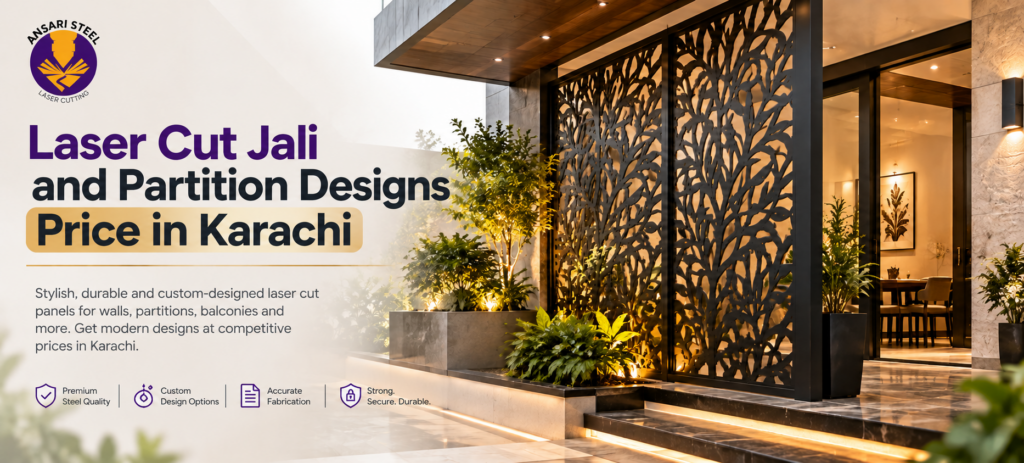
When planning a decorative metal screen, partition, staircase panel or boundary-wall feature in Karachi, one of the first questions is usually price. Buyers often search for Laser Cut Jali / Partition Design Price in Karachi expecting a standard rate, but custom metal fabrication does not normally work on one universal price. The Jali design price in Karachi can change according to the material, sheet thickness, dimensions, pattern, quantity and the fabrication work required after cutting.
laser-cut jali is produced by cutting a prepared digital pattern into a metal sheet. Depending on the project, the finished panel can be used as a decorative screen, room divider, balcony feature, staircase panel, boundary-wall insert, office partition or part of a fabricated door. Geometric, floral and customised patterns can all be developed where they are technically suitable for the selected material and application.
The important point for a buyer is that the cost of the metal sheet and the size of the panel are only part of the quotation. Design preparation, CNC cutting, bending, welding, framing, finishing and installation may also form part of the work. An accurate quotation therefore normally requires project-specific information rather than simply asking for a general rate per square foot.
Factors That Affect CNC Jali and Partition Price in Karachi
Material selection has a direct relationship with the quotation. Mild steel and stainless steel have different material characteristics and are chosen for different practical reasons. The grade, thickness and amount of metal required need to be considered alongside the intended location of the panel.
Sheet thickness or gauge is another important factor. Two panels may have exactly the same width and height but use different quantities of material because one is made from a thicker sheet. Thickness can also influence cutting and subsequent fabrication requirements. This is why comparing two quotations solely according to panel dimensions may not provide an accurate comparison.
The pattern itself also matters. A simple repeated geometric pattern may require a different amount of design preparation and cutting from a dense decorative pattern containing many small shapes and intricate cutting paths. Consequently, Partition design price in Karachi can vary even when the external dimensions of two panels are identical.
Pattern density is particularly relevant because a highly open design and a detailed design do not necessarily involve the same amount of cutting. Custom artwork can add another stage if an idea, sketch or reference image first needs to be converted into suitable vector or CAD artwork.
Quantity should also be specified. One custom panel and twenty repeated panels represent different fabrication requirements. If the same approved design is repeated, the design-development requirements may differ from a project in which every panel has unique dimensions or artwork.
Buyers frequently ask about CNC laser cutting price per square foot Karachi. A per-square-foot calculation may provide a useful starting point for budgeting, but it should not automatically be treated as the complete fabrication price. The final quotation can also reflect material, gauge, cutting complexity, vector preparation, bending, welding, finishing and installation.
When comparing workshops, understanding how to choose laser cutting service can help a buyer look beyond a single headline rate and consider whether the quotation actually covers the work needed for the finished project.
The Jali design price in Karachi should therefore be considered against a clearly defined specification. Providing accurate dimensions, material preference, thickness, design reference, quantity and intended application gives the fabricator a much stronger basis for preparing a relevant quotation.
Stainless Steel vs Mild Steel Jali
Stainless steel and mild steel can both be used for decorative metal fabrication, but they should not be treated as interchangeable materials. Their appearance, corrosion characteristics, maintenance requirements, fabrication considerations and costs differ, and the appropriate choice depends on the project.
For buyers researching Stainless steel jali design Karachi, appearance and resistance to corrosion may be important considerations. Stainless steel generally provides greater corrosion resistance than unprotected mild steel, but performance still depends on the grade, environment, fabrication and maintenance. It should not be described simply as a material that can never corrode.
Mild steel is widely used for general metal fabrication and can be suitable for many decorative and architectural applications. When considering Mild steel jali cutting price Karachi, the quotation should take account of the sheet specification, thickness, dimensions, cutting pattern and any finishing required for the intended environment.
A buyer comparing these options can use the stainless steel vs mild steel guide to understand how practical considerations such as environment, appearance and application can influence material selection.
The location of the panel should also influence the decision. An indoor decorative partition faces different environmental conditions from a balcony or boundary-wall panel exposed outdoors. Material choice should therefore consider where the jali will be installed, the desired appearance, maintenance expectations, fabrication requirements and available budget.
Neither stainless steel nor mild steel should automatically be described as the right option for every project. A suitable specification comes from matching the material to the application rather than choosing only according to an isolated material price.
Popular Jali Applications in Karachi
CNC-cut jali can be adapted to a wide range of residential and commercial applications. Although the same general cutting technology can be used, the dimensions, material, fabrication and installation requirements change considerably according to where the panel will be installed.
A Boundary wall jali design Karachi project may use decorative metal panels to create visual screening while retaining a patterned, relatively open appearance. The jali can become part of the overall architectural treatment of the boundary rather than simply functioning as a plain metal panel.
Staircase applications require a different approach. Decorative panels can provide enclosure while contributing to the visual character of the staircase. When evaluating Staircase jali design price, buyers should consider panel dimensions, material, gauge, pattern and any supporting fabrication instead of looking only at the decorative cutting.
For balconies, Balcony jali design Karachi can refer to decorative screening incorporated into the architectural design. Exposure conditions are especially relevant here, making material specification, finishing and maintenance important considerations alongside appearance.
Room partitions can divide spaces without necessarily creating a completely solid wall. A CNC cut screen partition Karachi project can be particularly useful where the design calls for visual separation while maintaining a sense of openness between two areas. This approach can work in homes, reception areas, offices, restaurants and other interiors depending on the project design.
Office screens follow similar principles but can be designed around workplace layouts and visual separation. The pattern, panel size and supporting structure can be adapted to the interior concept rather than treating every partition as a standard product.
Decorative jali patterns may also be incorporated into fabricated doors where appropriate. Buyers considering this type of work can review custom steel door fabrication with jali designs when planning how patterned metal elements could form part of a broader door fabrication requirement.
A Laser cut metal jali design may require more than the cutting of a flat sheet. Frames, supports and other components can require professional welding and fabrication work so that the cut panel can become part of the required fabricated assembly.
The practical purpose should therefore guide the design. Boundary walls require a different approach from interior screens, while staircase, balcony and door applications each have their own dimensions, surrounding structures and environmental considerations.
Design Options and Patterns for Laser-Cut Jali
CNC laser cutting allows a digital design to be translated into repeatable cutting paths. This provides considerable flexibility in the visual style of decorative metal panels, although every pattern still needs to be appropriate for the material, dimensions and intended fabrication.
Geometric patterns can use repeated lines, polygons and other structured shapes. They are often selected for modern architectural work because repetition can create a consistent visual rhythm across one or several panels.
Floral designs can introduce curves, leaves, flowers and more organic forms. Depending on the level of detail, these designs can require more involved artwork preparation and cutting than relatively simple geometric patterns.
Modern decorative patterns may combine geometric and organic elements. Repeated motifs can also be scaled or arranged across multiple panels where the overall design requires visual consistency.
A custom Laser cut metal jali design can begin with a customer’s own idea. This might be a sketch, reference image, existing pattern or professionally prepared drawing. However, a visual reference is not automatically a production-ready CNC file.
For a CNC cut screen partition Karachi project, design preparation should take account of actual panel dimensions and the intended appearance. Borders, spacing and the relationship between cut areas and remaining metal need to be considered when translating the concept into practical artwork.
Custom Vector and CAD Design
Vector and CAD preparation connects the initial concept with CNC manufacturing. The client’s visual idea first needs to be interpreted as accurate digital geometry. The required cutting paths can then be prepared in a form suitable for production.
A customer does not necessarily need to arrive with a completed CNC file. Where suitable design support is available, a sketch or concept may be developed into vector artwork or CAD drawings before fabrication.
Ansari Steel lists vector designing among its services, including CAD drawings and CNC-ready designs. Its custom vector and CAD design support is therefore relevant when a customer has a decorative concept that requires preparation before it can move into CNC cutting.
Proper artwork preparation can also reduce ambiguity. Dimensions, pattern placement and the overall layout can be reviewed before material is cut, helping connect the decorative concept with the practical requirements of fabrication.
Process From Vector Design to Final Installation
A custom jali or partition project generally begins by establishing where the panel will be used and what the customer wants it to achieve. Dimensions, material preference, design style and quantity provide the initial basis for discussing the work.
The next stage is design preparation. If the customer already has appropriate vector or CAD artwork, it can be reviewed against the fabrication requirements. If the customer only has a concept or reference image, additional design work may be needed to create CNC-ready artwork.
Once the design is ready, CNC cutting converts the digital cutting paths into the required shapes in the selected sheet material. Ansari Steel presents precision laser cutting services for precision cutting and the production of complex shapes and designs, with support for multiple materials.
Some projects require the cut metal to remain flat, while others require formed components. Where a panel, frame or related component needs controlled bends, precision sheet metal bending work can form part of the wider fabrication process.
After cutting and any required bending, components may need to be assembled or incorporated into frames. Welding requirements depend on the actual product being manufactured rather than being automatically necessary for every CNC-cut panel.
Finishing may also form part of the project depending on the selected material and required appearance. Installation, where required within the project scope, is the stage at which the fabricated components are positioned and fitted at the intended site.
For a buyer, understanding this sequence explains why the price of a finished partition cannot always be compared directly with a cutting-only quotation. A completed product can involve several separate stages of design and fabrication.
Ansari Steel for CNC Jali and Metal Fabrication Projects
Ansari Steel provides a range of services relevant to projects that extend beyond a single cutting operation. According to its official website, these include CNC works, vector and CAD designing, sheet-metal bending, welding, steel door making and broader metal fabrication.
Its CNC offering is presented around precision cutting and the ability to create complex shapes and designs. Its vector-designing service covers CAD drawings and CNC-ready designs, connecting design preparation with the manufacturing process.
This combination is relevant to custom jali work because a project may start with an idea rather than a completed production file. The design can require digital preparation before cutting, while the cut components may subsequently require bending, welding or other fabrication depending on the finished product.
The company’s complete steel fabrication services provide further context for customers whose requirements involve more than a standalone decorative sheet, including industrial, commercial and residential fabrication applications.
This does not mean that every jali project requires every service. A simple cut panel may have a comparatively limited scope, while a complete partition, fabricated door or architectural feature can involve several connected processes. Defining those requirements early helps establish which services are actually relevant.
Why Design, Material and Fabrication Method Matter for Price
Two panels measuring exactly the same width and height can receive different quotations because dimensions are only one part of the specification. One panel may use thicker material, another may contain a much denser cutting pattern, and another may require additional fabrication after CNC cutting.
This is particularly important when comparing Jali design price in Karachi. A relatively open repeated pattern and a detailed customised design may involve different design and cutting requirements even if both panels occupy the same number of square feet.
The same principle applies to Partition design price in Karachi. A customer requesting only a CNC-cut decorative sheet is not necessarily purchasing the same scope of work as someone requesting a complete framed partition that requires fabrication, finishing and installation.
Material specification can create another major difference. A quotation for Mild steel jali cutting price Karachi should be interpreted in relation to the actual gauge, panel dimensions, pattern, quantity and required fabrication rather than assuming that all mild-steel jali has one standard rate.
Likewise, CNC laser cutting price per square foot Karachi can be useful for understanding part of the calculation, but square footage alone does not describe pattern density, total cutting path, material thickness or additional workshop operations.
Custom artwork can also affect the project. A production-ready design requires less preliminary interpretation than a concept that still needs to be converted into vector or CAD artwork. The amount of preparation required depends on what the customer can provide and how complex the intended pattern is.
Bending and welding further change the scope. A flat panel supplied after cutting is a different product from a panel incorporated into a frame or other fabricated structure. Finishing and installation can add further project-specific requirements.
Quantity should be considered as well. Repeating an approved pattern across multiple panels is different from preparing several individually customised designs. Buyers should therefore compare complete specifications rather than assuming that apparently similar projects must receive identical quotations.
Ansari Steel and the Final Choice for a Custom Jali Project
Before requesting a quotation, it is useful to prepare the core information that defines the project. Accurate panel dimensions should be available wherever possible, along with the number of panels and their intended location.
Material preference should also be stated. If the required material or gauge has already been specified by a designer, architect or project requirement, that information should be shared. If it has not been decided, the intended use and exposure conditions can form part of the discussion with the fabricator.
The pattern is equally important. A customer with completed artwork should identify the available file format, while someone with only a reference image or concept should explain that design development may still be required.
Buyers should also state whether they need CNC cutting only or a completed fabricated item. Bending, welding, frames, finishing and installation should be identified where applicable because these can change both the production process and final quotation.
Ansari Steel lists CNC works, vector/CAD designing and wider fabrication capabilities among its services. For buyers considering a custom project, this means the discussion can focus on the actual stages required rather than assuming that every enquiry is simply a request to cut a sheet.
An accurate quotation ultimately depends on accurate project information. Dimensions, material, thickness, design, quantity, intended use and the required level of fabrication provide a much stronger pricing basis than asking only for a general rate.
Conclusion
The Laser Cut Jali / Partition Design Price in Karachi cannot responsibly be represented by one fixed figure. Material, dimensions, thickness, design complexity, pattern density, cutting requirements and quantity can all influence the quotation. Vector or CAD preparation, bending, welding, finishing and installation can further change the complete project cost.
For Karachi buyers, the most useful approach is to define the entire requirement before comparing prices. A per-square-foot figure can sometimes assist with initial budgeting, but it should not automatically be treated as the finished fabrication cost.
Ansari Steel provides CNC cutting, vector/CAD designing and related metal-fabrication services that can be relevant to custom jali, partition and other fabricated metal projects. Providing complete project details allows the required work to be assessed more accurately without relying on an assumed universal market rate.
FAQs About CNC Net and Partition Prices in Karachi
There is no single fixed CNC laser cutting price per square foot Karachi for every project. Material, thickness, panel dimensions, pattern density and fabrication requirements can change the quotation. Ansari Steel provides CNC cutting services, and its CNC laser cutting FAQs explain useful considerations when discussing a project-specific quotation.
The difference depends on material specification, grade, thickness, dimensions, design and finishing requirements. Stainless steel net design Karachi projects may also involve different corrosion and appearance considerations compared with mild-steel work. The appropriate material should therefore be chosen according to the application, exposure, maintenance expectations and budget rather than price alone.
There is no universal price for Boundary wall net design Karachi because dimensions, material, thickness, pattern and fabrication requirements vary. Ansari Steel provides complete steel fabrication services alongside CNC-related work, so buyers should clarify whether the requirement covers only cut panels or additional fabrication for the finished boundary-wall feature.
Design complexity can influence the quotation because dense patterns, numerous small details and longer cutting paths may require different preparation and cutting work compared with simple repeated patterns. Partition design price in Karachi should therefore be assessed from the actual artwork, dimensions, material, thickness and complete fabrication requirement rather than using one fixed complexity surcharge.
There is no single Staircase net design price because staircase panels can differ considerably in size, material, gauge, pattern and supporting fabrication. Ansari Steel provides precision CNC laser cutting services that can be relevant where customised staircase panels require CNC-cut patterns, but the complete project specification is needed for an accurate quotation.
The customer does not necessarily need to supply a finished vector or CAD file, but CNC cutting ultimately requires suitable digital artwork. A sketch, image or concept may first need conversion into CNC-ready geometry. Ansari Steel lists vector designing, CAD drawings and CNC-ready design preparation among its relevant services, allowing design requirements to be discussed before fabrication begins.
No metal should be described as universally rust-proof without considering its grade, environment and maintenance. Stainless steel generally offers greater corrosion resistance than unprotected mild steel, but suitability depends on the application and exposure. The laser cutting materials guide provides useful context when comparing materials for CNC-cut work.
There is no universal production time for a CNC cut screen partition Karachi project. The schedule can depend on whether artwork is ready, material requirements, panel quantity, pattern complexity and whether bending, welding, finishing or installation is included. A realistic timeframe should therefore be confirmed after the fabricator has reviewed the complete project specification.
Material weight and panel area can both contribute to estimating a project, but neither automatically represents the complete fabrication price. Ansari Steel provides CNC and broader fabrication services, while its laser cutting materials FAQs can help buyers understand material considerations. Design, cutting and additional fabrication can also affect the quotation.
The suitable option depends on the required appearance, privacy, openness, material and budget. A Laser cut metal net design can provide detailed and repeatable decorative patterns for partitions. Ansari Steel offers CNC laser cutting services for custom designs, but the final design should still be selected according to the room’s practical and architectural requirements.