
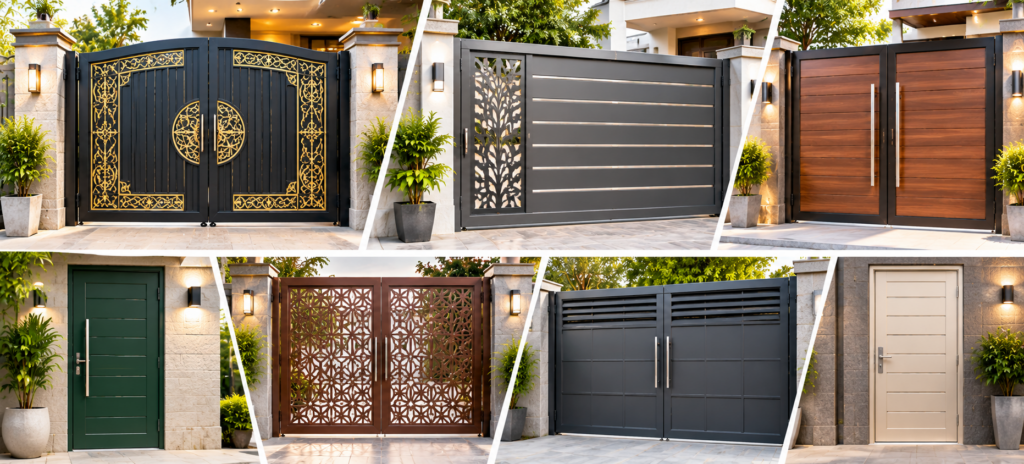
Finding a Reliable Steel Door Manufacturer in Karachi
Finding a reliable Steel door manufacturer in Karachi involves more than selecting an attractive entrance design. Homeowners need doors that fit their properties correctly, while builders, architects and commercial buyers require accurate fabrication, suitable materials and clearly defined manufacturing specifications.
A steel door is a complete working assembly. Its performance depends on the door leaf, frame construction, material thickness, reinforcement, hinges, locking arrangements, surface finishing and installation conditions. Even a visually impressive door can become difficult to operate if these elements are not properly coordinated.
Ansari Steel is a Karachi-based metal fabrication company that lists steel door making alongside CNC cutting, sheet-metal bending, welding and vector/CAD designing. Its published custom steel door fabrication services describe customised steel doors for residential and commercial applications, with an emphasis on fabrication, security considerations and modern architectural appearance.
For customers comparing an Iron door manufacturer in Karachi or a Steel door supplier in Karachi, understanding the difference between fabrication capability and a finished door package is particularly important.
This article explains the manufacturing considerations behind residential, commercial and project-based steel doors, including custom measurements, steel specifications, fabrication stages, protective finishes, quality checks, bulk orders and manufacturer selection.
The objective is to help buyers prepare accurate requirements, ask informed questions and obtain a quotation that reflects the actual work needed.
Types of Steel Doors We Manufacture
Steel doors can be specified for different building applications, but their construction should always reflect the intended use.
A manufacturer may work with residential entrance designs, internal doors, commercial access requirements and industrial fabrication enquiries. However, these categories do not automatically represent standard products available from every workshop.
Ansari Steel publishes custom steel door making for residential and commercial spaces. Other specialised applications should be discussed individually to confirm the company’s ability to manufacture the required construction.
Residential Main Entrance Steel Doors
Residential entrance doors must balance security, privacy, appearance and comfortable everyday operation.
A main entrance may require a solid steel panel, decorative metal detailing or a customised arrangement that complements the building elevation. The manufacturer must consider the available opening, door weight, hinge arrangement, frame dimensions and locking requirements.
For homes in Karachi, exposure is another consideration. A sheltered apartment entrance may face different environmental conditions from a street-facing entrance exposed to rain, humidity and dust.
Custom fabrication allows buyers to discuss the required dimensions and visual appearance before production. However, the selected construction must remain compatible with the door’s intended function.
Interior and Internal-Use Steel Doors
Some buildings require metal doors for storerooms, service areas, utility spaces or other internal openings.
These applications may prioritise practical access, ease of cleaning, suitable hardware and compatibility with the surrounding wall construction.
An internal steel door does not necessarily need the same weather protection or decorative treatment as an external entrance. Nevertheless, material thickness, frame alignment, opening direction and hardware remain important.
Buyers should explain the intended location and operating requirements rather than assuming that one general steel door specification will suit every room.
Security-Oriented Steel Doors
Security-oriented doors require more consideration than simply increasing the thickness of the visible steel panel.
The door leaf, frame, reinforcement, hinges, locking points and surrounding wall connections must function together.
A heavier door panel fitted into an unsuitable frame may not provide the protection the buyer expects. Similarly, decorative cut-outs can affect the available solid material and must be evaluated carefully.
Customers seeking security-focused fabrication should describe the required protection level and ask the manufacturer to explain the proposed construction. Specific security ratings or resistance claims require appropriate evidence and should never be assumed.
Commercial Steel Entrance Doors
Commercial entrances may experience frequent opening, repeated handling, staff movement and deliveries.
The manufacturing specification should consider the expected frequency of use, opening dimensions, door configuration, hardware compatibility and maintenance requirements.
Office entrances, retail properties and other commercial openings may therefore require different arrangements from residential doors.
For a more detailed explanation of these differences, readers can explore steel doors for residential and commercial buildings.
Industrial and Factory-Related Door Requirements
Factories, warehouses and industrial properties may require steel access doors for personnel, maintenance areas or operational spaces.
The relevant requirements depend on the opening dimensions, working environment, frequency of use and any applicable building or safety obligations.
Industrial door specifications may involve additional technical assessment, particularly where specialised access, emergency escape or certified performance is required.
These requirements should be confirmed before assuming that a general metal fabrication service covers the complete product.
Custom CNC Decorative Steel Doors
A buyer searching for a Custom steel door maker Karachi may have a specific geometric pattern, architectural reference or decorative metal panel in mind.
CNC laser cutting can support selected decorative components by producing accurately defined shapes from suitable material.
However, a CNC-cut decorative panel is not the same as the structural door frame.
The size and position of cut-outs, remaining metal connections, panel support and fixing arrangements must be assessed against the intended construction. An intricate pattern should not compromise the functional requirements of the completed door.
Customisation is most successful when appearance, fabrication feasibility and everyday operation are considered together.
Custom Sizes, Gauges and Finishes for Steel Doors
Custom steel door manufacturing begins with an accurate understanding of the opening and the required finished assembly.
Two properties may have apparently similar entrance dimensions but require different frame depths, clearances, fixing arrangements and door configurations.
Accurate Door Measurements and Opening Dimensions
A manufacturer needs more information than the approximate height and width of a doorway.
The wall opening, finished floor level, wall thickness and surrounding construction can all influence the final dimensions.
Measurements should account for plaster, tiles, flooring and other finishes where relevant. Existing openings may also be uneven or out of square, particularly in renovation projects.
The door leaf must be distinguished from the complete door-and-frame assembly. Appropriate clearances are required for opening, closing and hardware operation.
A single-leaf entrance, double-leaf arrangement or unusually tall door may require different fabrication details.
Before manufacturing begins, buyers should confirm who is responsible for taking and approving the final measurements.
Understanding Steel Gauge and Material Thickness
Steel gauge is frequently discussed when ordering fabricated doors, but gauge numbers alone can be misleading.
Different measurement conventions may be used, and the relationship between gauge numbers and actual thickness is not always understood consistently.
For this reason, the written specification should identify the actual material thickness in millimetres.
The thickness of the outer sheet should also be distinguished from the thickness and dimensions of frame sections, internal members and reinforcement.
No single steel thickness is suitable for every door.
The correct selection depends on the door’s dimensions, intended use, material characteristics, construction, hardware, weight and exposure conditions.
Buyers should ask the manufacturer to explain how the proposed material specification relates to the complete assembly rather than relying on descriptions such as heavy-duty steel.
Steel Door Frames and Chokhat Construction
The chokhat is the fixed frame that supports the door and provides the connection between the moving leaf and the surrounding opening.
Its dimensions must correspond with the wall construction, hinge positions, door weight and installation arrangement.
Frame alignment is particularly important because an incorrectly positioned chokhat can affect closing gaps, lock engagement and smooth movement.
Customers should confirm whether the frame is included in the quotation or must be ordered separately.
Decorative Appearance and Custom Finishes
A custom door can be designed to complement a residential elevation or commercial architectural scheme.
Simple panel arrangements, geometric patterns and selected decorative metal components may be considered where technically suitable.
Buyers looking for visual references can review customised iron main door design ideas before discussing a fabrication-ready design.
Finishing requires equally careful consideration.
Paint systems, powder coating and suitable anti-corrosion treatments are possible specifications in steel fabrication, but their availability and suitability must be confirmed for each order.
Ansari Steel describes modern finishing and rust-resistant materials in its steel door service information. However, the exact material, surface preparation and protective system for a particular door should be established in writing.
Protecting Steel Doors in Karachi’s Climate
Karachi’s humidity, seasonal rainfall, dust and coastal exposure can contribute to corrosion, particularly where steel surfaces are damaged or inadequately protected.
Moisture may collect around joints, edges, hinges and poorly drained areas.
Appropriate surface preparation and protective finishing can help reduce corrosion risks, but no coating should automatically be described as completely rust-proof.
Regular inspection, cleaning and timely repair of damaged finishes remain important.
Buyers comparing a Security steel door manufacturer Karachi should therefore examine both the proposed construction and the environmental protection requirements.
A security-oriented specification should not overlook corrosion, hardware maintenance or frame condition.
How We Make a Steel Door: From Measurement to Installation
Understanding the fabrication process helps buyers recognise why custom steel doors require careful planning.
The precise manufacturing sequence varies according to the approved design, material specification and required components. Nevertheless, several stages are commonly relevant.
Understanding the Customer’s Requirements
The initial discussion should establish where the door will be used and what it must achieve.
A manufacturer needs to understand whether the opening serves a residential entrance, internal room, commercial property or another application.
The customer should explain the approximate dimensions, opening direction, preferred appearance, frame requirements, hardware expectations and environmental exposure.
Existing drawings, photographs and architectural references can help communicate the intended result.
At this stage, the manufacturer can identify which details require clarification before a reliable quotation can be prepared.
Site Measurement and Dimensional Verification
Accurate measurement is essential because fabricated steel components cannot always be adjusted easily after completion.
The opening width and height should be checked against the actual site conditions. Wall thickness, floor finishes, available swing space and adjacent construction may also need consideration.
Where the manufacturer is not responsible for visiting the site, the customer or appointed contractor should establish who will verify the final dimensions.
A Steel door factory in Karachi should work from clearly agreed measurements rather than relying solely on approximate verbal descriptions.
Incorrect measurements can result in installation difficulties, unnecessary alterations and additional fabrication costs.
Design Preparation and Customer Approval
A photograph or hand-drawn sketch may communicate the intended appearance, but it does not necessarily provide enough information for fabrication.
A more detailed drawing can establish panel dimensions, overall proportions, cut-out positions, frame relationships and hardware locations.
Vector or CAD preparation can be particularly useful for customised decorative patterns and components requiring accurate cutting.
Ansari Steel lists vector/CAD designing among its published fabrication services, including CAD drawings and CNC-ready design preparation.
Before production begins, the customer should approve the relevant drawing and confirm that the dimensions, appearance and construction requirements are understood.
Changes after material cutting or assembly may require additional work.
CNC Laser Cutting and Component Preparation
CNC laser cutting uses digitally controlled equipment to produce shapes according to prepared cutting information.
It can be useful for selected decorative panels, geometric patterns, openings and other components requiring accurate profiles.
Ansari Steel’s published precision CNC laser cutting service describes complex shape fabrication, clean edges and custom CNC designs.
For a steel door, CNC work may support a particular design element rather than the complete manufacturing process.
The fabricator must consider the material, component dimensions, cut-out arrangement and subsequent assembly requirements.
Precision cutting improves control over the geometry of suitable components, but it does not independently establish the security or strength of a finished door.
Sheet-Metal Bending and Forming
Some door designs require flat metal to be formed into angles, folds, channels or shaped profiles.
Bending can help create components that correspond with an approved fabrication drawing.
Ansari Steel lists professional sheet metal bending for custom metal shapes, accurate bends and fabrication applications.
The bending method depends on the material, thickness, geometry and required result.
Bend allowances, achievable radii and dimensional accuracy may need consideration when preparing components.
Not every door requires the same bending operations. Some assemblies may use different combinations of sheet metal and prepared sections.
Welding and Door Assembly
Once suitable components have been prepared, welding may be required to join the fabricated elements.
Welding can be used in frame construction, panel assembly and other appropriate metal connections.
Ansari Steel publishes specialised steel welding services and identifies MIG, TIG and ARC welding within its broader capabilities.
The appropriate process depends on the material, joint design, thickness and fabrication requirements.
During assembly, maintaining alignment is essential. Distortion or inaccurate positioning can affect the relationship between the door leaf, frame and hardware.
Welded connections should be assessed according to the agreed construction requirements rather than judged only by their visible appearance.
Grinding, Surface Preparation and Finishing
Following assembly, a project may require grinding, edge preparation, surface cleaning and finishing.
Sharp edges, unwanted surface contamination and unsuitable preparation can affect both handling and coating performance.
The exact finishing sequence depends on the approved specification.
For external steel doors, protective treatment should be considered in relation to moisture exposure, joints, edges and areas around hardware.
Customers should confirm which finishing operations are included and whether any additional treatment is required after installation.
Quality Inspection Before Dispatch
A completed door should be assessed against the agreed dimensions and construction requirements.
Relevant checks may include overall width and height, frame alignment, panel fit, hinge positioning, operating clearance and compatibility with the specified locking arrangement.
The finish should also be examined for visible defects and areas requiring correction.
Where hardware is included, its operation should be checked before handover where practical.
These checks help identify problems before the door reaches the installation site.
Delivery, Fitting and Installation Responsibilities
Installation is the stage at which the fabricated assembly must work with the actual building opening.
Correct frame positioning, suitable fixing arrangements and proper door alignment are important.
Ansari Steel’s steel door service page mentions professional installation. However, customers must confirm whether fitting is available for their location and included in the individual quotation.
Transport, unloading, removal of an existing door, civil alterations and final adjustment should also be clarified.
A manufacturing quotation should never be assumed to include every installation-related activity unless the agreed scope expressly states so.
Steel Doors for Builders, Contractors and Bulk Projects
Project-based steel door fabrication requires more coordination than an individual residential order.
Builders, developers, architects and contractors may need multiple doors with different dimensions, finishes, frames and hardware arrangements.
The phrase Steel door for builders and contractors reflects a practical procurement requirement: the finished products must correspond with approved drawings, construction progress and installation conditions.
Coordinating Door Requirements Across a Project
A residential development may contain main entrance doors, internal utility doors and shared access openings.
Commercial projects may require different configurations for offices, service rooms and operational areas.
A factory project can introduce further requirements involving access arrangements, environmental exposure and specialised hardware.
These doors should not automatically share one material or construction specification.
A door schedule can identify the opening reference, intended application, dimensions, configuration, frame requirements and required finish.
Consistent documentation helps reduce confusion between the architect, contractor, fabricator and installation team.
Preparing Drawings and Specifications
Project buyers should provide available architectural drawings, door schedules, quantities, site locations and design references.
Where relevant, the documentation should identify wall thicknesses, finished floor levels, opening directions and hardware requirements.
The manufacturer can then review the proposed fabrication scope and clarify missing information.
Contractors managing related metalwork may also benefit from understanding steel fabrication for construction projects, particularly where drawings, dimensional accuracy and site coordination affect multiple fabricated components.
Commercial Door Fabrication Requirements
A buyer searching for Commercial steel door manufacturer Karachi should evaluate whether the fabricator can address the intended commercial application.
Frequent use, access control arrangements, maintenance requirements and site conditions may influence the specification.
Some commercial buildings also have statutory or project-specific requirements involving fire safety, accessibility or emergency escape.
These requirements must be identified by the appropriate project professionals. General steel door fabrication does not establish fire-rated performance or regulatory compliance.
Bulk Steel Door Orders and Production Planning
A Steel door bulk order Karachi enquiry should begin with the required quantity and a clear description of each door type.
Repeated designs may simplify drawing coordination, but variations in opening dimensions, finishes or hardware can still affect fabrication.
Production planning should account for drawing approval, material availability, fabrication stages, finishing and the agreed dispatch sequence.
Where construction is being completed in phases, the contractor should discuss whether staged supply is practical.
Ansari Steel can be approached regarding its published custom steel door and fabrication services, but current bulk-order acceptance, minimum quantities, manufacturing capacity and delivery arrangements require direct confirmation.
No fixed production period or volume discount should be assumed without a project-specific agreement.
How to Choose a Reliable Steel Door Manufacturer in Karachi
Selecting a manufacturer requires assessing actual fabrication capability and the clarity of the proposed specification.
A supplier may source finished doors, a fabricator may manufacture customised components, and an installer may fit completed assemblies.
Some businesses perform several of these roles, but customers should establish exactly which responsibilities are included.
Evaluate Material and Fabrication Specifications
Ask what material will be used and request measurable information about the relevant sheet thickness and sections.
Descriptions such as premium steel or heavy-duty construction are not substitutes for a written specification.
Frame construction, reinforcement, hinge compatibility and hardware requirements should also be discussed.
A suitable manufacturer should be able to explain how the proposed fabrication relates to the intended application.
Review Genuine Manufacturing Evidence
Previous work can help buyers understand a company’s fabrication activities.
Genuine photographs of cutting, bending, welding, assembly and completed projects may provide useful evidence.
When reviewing images, consider whether they actually show the type of work being discussed.
A CNC cutting photograph demonstrates a process, but it does not necessarily prove that the company manufactured a particular completed door.
For Ansari Steel, the published project gallery provides a starting point for reviewing broader metal fabrication work. Customers seeking evidence of a specific door category should request relevant completed-project photographs and confirmed details.
Compare Written Quotations
A reliable quotation should clearly describe what the customer will receive.
Dimensions, material specifications, door construction, frame requirements, design preparation, finishing and hardware should be identified where relevant.
The quotation should also clarify transport, installation, site measurement and any exclusions.
Warranty documentation deserves similar attention. Buyers should ask whether any warranty applies, which components or workmanship it covers and what conditions govern a claim.
A warranty period should never be assumed from general promotional wording.
Consider Location and Workshop Access
Someone searching for Steel door manufacturer near me should assess more than the apparent distance shown in local search results.
The manufacturer’s actual location, service scope, workshop access and ability to handle the required fabrication are more important than an unsupported claim of proximity.
A workshop visit may help buyers examine relevant work, but access should be confirmed and an appointment arranged before travelling.
For customers comparing a Steel door manufacturer in Pakistan, local manufacturing capability should also be distinguished from nationwide supply or installation.
A company operating in Karachi should not automatically be assumed to deliver or install across Pakistan.
How Ansari Steel Approaches Custom Steel Door Manufacturing
Ansari Steel presents steel door making as part of its broader metal fabrication activities rather than simply offering a catalogue of ready-made doors.
Its official information identifies customised steel doors for residential and commercial spaces, alongside CNC works, bending, welding and vector/CAD designing.
These capabilities are relevant because a custom door may require several different fabrication operations.
A decorative panel might require digitally prepared artwork and precision cutting. A formed component may require bending, while selected assemblies may involve welding.
However, the combination of processes depends on the approved design.
The company’s published Ansari Steel’s metal fabrication capabilities also include wider industrial, commercial and residential metalwork, providing context for its fabrication-focused services.
Importantly, an individual service does not automatically constitute a complete door order.
CNC cutting alone does not include a finished door leaf, frame, lock, hinges, protective coating or installation.
Likewise, the availability of welding and bending services does not establish that every possible steel door construction can be manufactured.
Customers should submit their drawings and requirements for a project-specific review.
The appropriate outcome is a clearly defined manufacturing scope that connects the proposed fabrication operations with the finished product the customer expects.
Why Consider Ansari Steel for Residential and Project-Based Steel Doors
Ansari Steel is a relevant Karachi-based business to consider when an enquiry involves custom steel door making and related metal fabrication.
Its published service categories include steel door making, CNC cutting, bending, welding and vector/CAD designing.
For residential buyers, these capabilities may be relevant when discussing a customised entrance, decorative metal components or a door designed around particular opening dimensions.
For contractors and commercial buyers, the broader fabrication services may be useful when reviewing drawings, component requirements and the manufacturing scope for multiple openings.
The company lists its contact location as:
Plot No. 03, Babar Market, Landhi No. 03, Karachi.
This is its published contact location, not a guarantee of unrestricted showroom or workshop access. Visitors should confirm the appropriate arrangements directly.
Customers can make an enquiry more productive by sharing accurate measurements, photographs of the opening, reference designs, required quantities and the intended application.
Material preferences, frame requirements, finishing expectations, hardware and installation location should also be communicated.
Ansari Steel’s suitability for a particular order should then be assessed against the agreed specification, available services and written quotation.
This approach allows buyers to evaluate actual fabrication requirements without relying on unsupported promises about production capacity, delivery speed or guaranteed performance.
Conclusion: Choosing the Right Steel Door Manufacturer in Karachi
Choosing a Steel door manufacturer in Karachi should begin with a clear understanding of the required door rather than appearance or price alone.
Accurate measurements, suitable material thickness, frame construction, fabrication methods, protective finishing, hardware and installation responsibilities all influence the finished assembly.
Residential entrances, commercial openings and bulk construction projects may require different specifications, even when the doors appear visually similar.
Ansari Steel offers published steel door making and related metal fabrication services, including CNC cutting, bending, welding and vector/CAD designing. These capabilities make it a relevant company to consider for customised steel door enquiries in Karachi.
Before placing an order, share the opening dimensions, preferred design, application, quantity and required specifications. Request a project-specific quotation that clearly establishes the materials, fabrication work, finishing, hardware and any agreed installation responsibilities.
A well-defined manufacturing scope is the foundation of a more accurate quotation and a steel door that is suitable for its intended application.
FAQs About Steel Door Manufacturer in Karachi
A reliable Steel door manufacturer in Karachi should provide clear specifications, relevant fabrication capability and genuine work examples. Ansari Steel is worth considering because its published Ansari Steel’s fabrication service range includes custom steel door making, CNC cutting, bending and welding. Compare quotations before deciding.
Yes, custom steel doors can be manufactured around specific opening dimensions and approved designs. A Custom steel door maker Karachi should review measurements, frame requirements and design feasibility before fabrication. Ansari Steel lists customised steel door making, but customers should confirm their preferred dimensions, construction and finish directly.
Manufacturing time depends on door dimensions, design complexity, material availability, fabrication requirements, finishing and order quantity. Ansari Steel does not establish one universal production period for every custom door. Customers should request an agreed manufacturing schedule after their drawings, specifications and project scope have been reviewed.
There is no universally suitable steel gauge for every door. Thickness depends on the opening dimensions, intended application, frame construction, reinforcement and hardware. Ansari Steel customers should request the actual material thickness in millimetres rather than relying on gauge terminology alone. The complete assembly must be considered before selection.
A steel door can be supplied with a matching chokhat, but frame inclusion depends on the manufacturer’s quotation. Ansari Steel customers should confirm frame dimensions, material thickness, fixing requirements and whether fitting is included. Its guide to steel door frame and chokhat details explains the key considerations.
A Steel door bulk order Karachi enquiry should specify quantities, dimensions, designs, frames and required delivery arrangements. Ansari Steel has not established a universal minimum order quantity in the information reviewed. Builders and contractors can discuss your steel door requirements directly to confirm current order acceptance and project scope.
Ansari Steel mentions professional installation on its steel door service page, but inclusion must be confirmed for each order. Customers should ask whether measurement, transport, frame fitting, hardware adjustment and installation are covered. The agreed quotation should also identify the installation location, site preparation responsibilities and any excluded work.
Karachi’s humidity, rain, dust and coastal air can increase corrosion risks. Suitable surface preparation, protective finishing and maintenance help protect exposed steel. Ansari Steel customers can review practical steel rust prevention methods and confirm the actual treatment specified for their door. No finish should be assumed completely rust-proof.
Ansari Steel lists Plot No. 03, Babar Market, Landhi No. 03, Karachi, as its contact location. However, this does not confirm unrestricted workshop access. Customers should contact the company before travelling, request an appointment and ask whether relevant fabrication samples or completed door photographs are available for review.
Provide Ansari Steel with opening measurements, design references, intended use, material preferences, frame requirements, quantity, finish, location and installation expectations. A Steel door supplier in Karachi should clarify inclusions and exclusions. Review factors that influence steel door pricing before comparing quotations.