
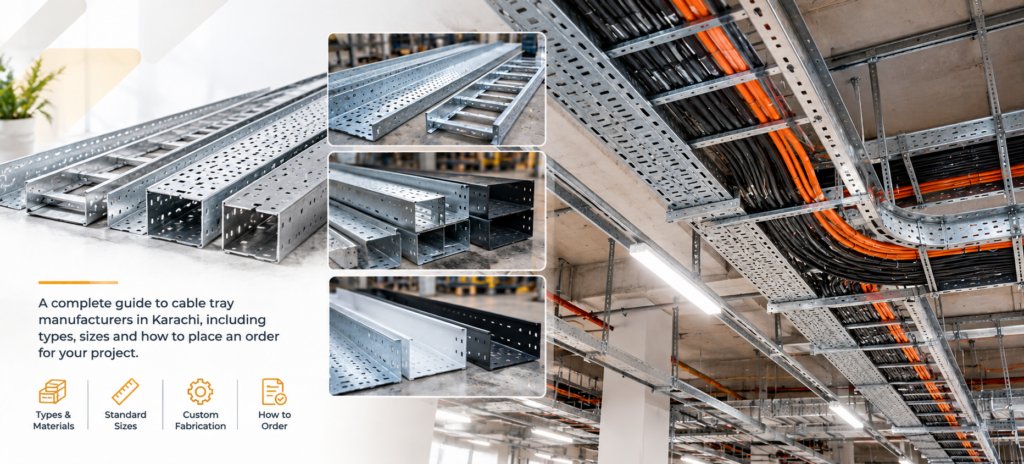
Choosing the right Cable tray manufacturer in Karachi is an important decision for factories, warehouses, commercial buildings and industrial electrical projects. Cable trays provide organised support and routing for power, control, instrumentation and communication cables, helping electrical systems remain accessible for inspection, maintenance and future modifications.
However, selecting a cable tray involves more than comparing prices. Tray design, width, depth, sheet thickness, material, protective finish, cable weight, support spacing, fittings and installation environment all influence whether a system is suitable for its intended application.
Ansari Steel is a Karachi-based steel fabrication business that lists industrial cable tray manufacturing alongside CNC cutting, sheet metal bending, welding and related fabrication services.
Understanding how cable trays are designed and manufactured helps buyers communicate their requirements accurately, avoid specification mismatches and obtain quotations that reflect the actual project scope.
Types of Cable Trays Available for Industrial and Commercial Projects
Cable trays are available in several designs, each intended to meet different cable support, ventilation, accessibility and protection requirements.
The appropriate design depends on cable diameter, quantity, weight, route complexity, environmental exposure and the supporting structure. A tray suitable for communication cables in an office may not meet the loading requirements of a large industrial power distribution system.
Perforated Cable Trays
Perforated cable trays are typically manufactured from formed metal sheets with openings distributed across the base. These openings allow some ventilation and drainage while maintaining a supporting surface beneath the cables.
They are commonly considered for factories, electrical rooms, commercial buildings, warehouses and suitable industrial installations containing power, control or instrumentation cables.
When evaluating a Perforated cable tray manufacturer, buyers should examine base width, side-wall depth, perforation pattern, sheet thickness, edge treatment and protective finish.
The perforation arrangement affects the remaining metal section and may influence the tray’s structural performance. Wider trays or heavier cable loads require particular attention to support spacing and design capacity.
Perforated construction does not automatically make a tray suitable for heavy-duty applications. Its suitability must be established against the proposed cable loading and installation conditions.
Ladder Cable Trays
Ladder cable trays consist of two longitudinal side rails connected by regularly spaced transverse rungs. Their open construction provides ventilation and access to cables along the route.
These systems are commonly considered for industrial power distribution, manufacturing plants, equipment areas and other installations where cable support and accessibility are important.
Buyers searching for a Ladder type cable tray manufacturer Karachi should examine side-rail construction, rung spacing, width, material thickness, connection details and the proposed distance between supports.
Rung spacing should suit the cables being installed. Some cables require more frequent support or additional securing arrangements.
Ladder trays are not automatically stronger than perforated trays. Actual performance depends on material, profile geometry, connections, support span and engineering design.
Wire Mesh Cable Trays
Wire mesh cable trays are constructed from interconnected metal wires forming an open basket-like pathway.
Their open structure provides ventilation and accessibility, making them a potential option for data networks, communication cables, low-voltage systems and other appropriately designed installations.
Important specifications include wire diameter, mesh spacing, overall width, side height, edge finishing, material and mounting arrangements.
Sharp wire ends, unsuitable connections or inadequate support can create installation problems. Buyers should also verify the system’s load suitability rather than assuming all wire mesh trays can support the same cable weight.
Wire mesh trays are a recognised industry option, but their availability from Ansari Steel should be confirmed directly before including them in a procurement schedule.
Cable Trunking
Cable trunking differs from conventional open cable trays because it provides a substantially enclosed or partially enclosed pathway.
It may be selected where additional physical protection, cable segregation, a cleaner appearance or controlled access is required.
Trunking can be useful in commercial interiors, electrical service areas and certain industrial environments. However, enclosure can restrict ventilation and may make cable access more involved.
Buyers should consider removable lids, internal dimensions, cable entry points, joint arrangements and the intended operating environment.
Trunking should not be treated as an automatically available Ansari Steel product without confirmation of the required design.
Cable Trays with Covers
Cable tray covers provide additional protection against falling debris, dust and certain environmental exposures.
Covers may be useful in selected industrial locations, overhead installations or areas where cables need protection from material falling onto the tray.
However, a covered tray is not necessarily waterproof or dust-tight. Cover design, joints, fixing arrangements and installation conditions determine the protection achieved.
Covers may also affect ventilation and maintenance accessibility.
Buyers should specify whether covers are required, their dimensions, fixing method and compatibility with bends and other fittings. They should not assume that covers are included with every cable tray order.
Cable Tray Sizes and Specifications for Standard and Custom Orders
Understanding Cable tray sizes and specifications is essential before requesting manufacturing quotations.
Tray width is usually one of the first measurements buyers identify. However, nominal width and usable internal width may differ because of side-wall geometry, flanges or return edges.
Side-wall depth, sometimes called tray height, determines the available containment space and contributes to the tray profile’s structural behaviour.
Overall length and straight-section length must also be specified. A project requiring a particular total route length may need multiple straight sections joined together, with allowance for fittings and installation conditions.
Sheet thickness is another important consideration. Buyers should specify actual thickness in millimetres where possible because gauge descriptions can vary between systems and suppliers.
The correct thickness depends on cable loading, tray width, profile design, support spacing and applicable engineering requirements.
Material grade and type must be identified separately from thickness. Two trays with identical dimensions may behave differently if their materials, forming details or protective treatments differ.
For perforated trays, buyers should provide opening dimensions, spacing and the required perforation arrangement. Ladder trays require corresponding details for rung spacing, rung construction and connections to the side rails.
Additional specifications may include cover dimensions, flange widths, return-edge geometry, joint plates, fasteners, mounting arrangements and fitting compatibility.
Horizontal bends, vertical bends, tees, reducers and level changes require particular attention. Their dimensions should follow the approved route, while bend radius must accommodate the installed cables and their permitted bending requirements.
Support requirements are equally important. A tray should not be selected independently of its brackets, fixing arrangement and proposed support intervals.
There is no universal tray width, depth or thickness suitable for every installation. Final dimensions should reflect cable quantity, cable diameter, total weight, future capacity, route geometry and approved project drawings.
Standard Requirements and Custom Fabrication
Standardised tray dimensions can simplify purchasing when the required configuration is available. However, projects involving restricted spaces, unusual routing or specific equipment connections may require custom fabrication.
A Custom cable tray manufacturer in Pakistan may be approached for drawing-based requirements involving particular widths, depths, lengths, sheet thicknesses, perforation arrangements, angles or return edges.
Ansari Steel advertises multiple cable tray sizes and related metal fabrication capabilities. These services are relevant to discussing drawing-based components, although the availability of any exact specification must be confirmed.
Manufacturing tolerances should be agreed before production. For example, buyers should establish acceptable dimensional variation for tray width, formed angles, connection holes and mating components.
Unspecified tolerances can create problems when components are assembled on site, particularly where multiple batches must connect accurately.
The approved drawing should therefore identify critical measurements, connection details and acceptance requirements rather than relying only on a verbal description.
Material and Finish Options for Cable Tray Manufacturing
Material selection affects corrosion resistance, structural behaviour, maintenance requirements and long-term suitability.
Buyers should consider whether the installation is indoors or outdoors, whether moisture or chemicals are present, and how much mechanical loading the tray must support.
Galvanized Steel
Galvanized steel receives a protective zinc coating that helps reduce corrosion of the underlying steel.
Two commonly discussed options are pre-galvanised steel and hot-dip galvanising after fabrication.
Pre-galvanised material is coated before subsequent cutting and forming. Depending on the fabrication process, cut edges and affected areas may require particular attention.
Hot-dip galvanising after fabrication applies zinc to the completed steel component through a controlled coating process. Component geometry, drainage arrangements and dimensional requirements must be considered when this method is specified.
Buyers approaching a Galvanized cable tray manufacturer in Karachi should confirm the required galvanising method, coating specification, treatment of joints and edges, and inspection requirements.
Ansari Steel advertises corrosion-resistant cable tray options, but the exact coating process, coating thickness and availability for a particular order require written confirmation.
Powder Coated Steel
Powder coating involves applying a dry coating material to a prepared surface and curing it to form a protective and decorative layer.
It may be selected for indoor commercial installations, visible service areas or applications requiring a particular colour and appearance.
Surface preparation is essential. Poor cleaning, contamination or unsuitable pretreatment can affect coating adhesion and performance.
A Powder coated cable tray manufacturer should be able to clarify the coating system, colour, preparation requirements, curing arrangements and finish acceptance criteria.
Powder coating should not automatically be considered more corrosion-resistant than galvanising. Performance depends on the complete coating system and environmental exposure.
Buyers should confirm whether the requested powder-coated finish can be supplied by Ansari Steel, including whether finishing forms part of the quoted manufacturing scope.
Stainless Steel
Stainless steel may be appropriate for certain coastal, moisture-exposed, chemical-processing, hygiene-sensitive or frequently washed environments.
Its suitability depends on the specific grade, exposure conditions and fabrication details.
Different stainless steel grades offer different corrosion-resistance characteristics. A grade suitable for a protected indoor environment may not provide the required performance under aggressive chloride or chemical exposure.
Buyers comparing materials can consult the company’s stainless steel vs mild steel discussion before confirming their project specification.
Availability of a particular stainless steel grade from Ansari Steel should be established through a technical enquiry.
Mild Steel and Other Suitable Materials
Mild steel is commonly used for general metal fabrication and may be suitable for cable trays where the structural design and surface protection match the installation environment.
It offers fabrication flexibility, but untreated mild steel can corrode when exposed to moisture and other aggressive conditions.
Aluminium is another industry material considered for some cable tray systems because of its relatively low weight and corrosion-related characteristics. Its suitability depends on the actual alloy, loading, connections and environment.
Aluminium tray availability from Ansari Steel is not established by its general steel fabrication information.
Material selection should consider expected service conditions and maintenance rather than initial purchase cost alone.
Corrosion Protection in Karachi
Karachi’s coastal air, humidity, industrial pollution and moisture exposure make corrosion protection an important specification consideration.
Outdoor cable routes, exposed industrial areas and installations near aggressive processes may require different protection from trays installed inside controlled commercial spaces.
Surface preparation, protective coating selection, treatment of cut edges, weld finishing and drainage all influence corrosion behaviour.
Water accumulation, damaged coatings and incompatible connections can create localised deterioration.
No finish should be assumed to provide a permanently rust-free service life. Appropriate inspection and maintenance remain important.
How Cable Trays Are Manufactured: Cutting, Bending and Welding
Cable tray manufacturing begins with an approved design rather than the cutting machine.
The drawing should establish tray dimensions, material thickness, hole patterns, bend positions, connection arrangements and any components requiring assembly.
The manufacturer then determines which operations are appropriate for the approved design.
Drawing Preparation and CNC Cutting
Accurate drawing preparation helps reduce dimensional inconsistencies and unnecessary material waste.
CAD or vector-based information can define cutting profiles, openings, connection holes and component outlines.
Ansari Steel advertises vector designing and CNC-related preparation alongside its CNC laser cutting capabilities.
For suitable sheet-metal components, CNC cutting can support repeatable preparation of parts according to the approved cutting pattern.
However, machine accuracy alone does not establish finished-product accuracy. Material condition, cutting settings, forming operations and inspection also influence the result.
Sheet Metal Bending and Forming
After suitable components have been prepared, forming operations create the required side walls, flanges, returns and profile angles.
Bending accuracy is particularly important where straight sections must align with connectors, covers or adjoining fittings.
Ansari Steel lists sheet metal bending among its fabrication services, including custom angles and shapes.
Buyers should confirm bend positions, inside dimensions, flange details and any critical fit requirements before approving production.
Welding and Component Assembly
Some cable tray designs or associated components require welded joints, while others rely mainly on formed sections and mechanical connections.
Welding may be relevant to selected ladder assemblies, fabricated brackets or other design-dependent components.
Ansari Steel lists MIG, TIG and ARC welding services.
The appropriate method depends on the material, component geometry, joint requirements and approved fabrication procedure.
Not every tray requires welding, and no single product should be assumed to use all three methods.
Finishing and Inspection
After fabrication, components should be checked against their approved dimensions and specified finish requirements.
Relevant checks may include profile alignment, connection-hole positions, burr removal, edge condition, weld appearance and coating integrity.
Inspection requirements should be proportionate to the project specification and agreed acceptance criteria.
Where external protective finishing is required, its availability, responsibility and inspection arrangements should be confirmed before manufacturing begins.
How to Order Custom Cable Trays: From Drawing to Delivery
Ordering cable trays successfully starts with identifying the application and understanding the cable route.
An electrical contractor should first determine where cables originate, where they terminate and which areas the route must pass through.
The selected tray design should reflect cable type, weight, ventilation requirements and accessibility.
Next, the installation environment must be assessed. Indoor electrical rooms, outdoor industrial areas and moisture-exposed facilities may require different materials or finishes.
Accurate site measurements are then needed to identify straight runs, bends, level changes, structural obstructions and connection points.
Support locations should be considered early because support spacing influences the required tray construction.
Once the route is understood, the buyer can prepare the manufacturing specification. This should identify tray type, width, depth, straight-section length, sheet thickness, material and protective finish.
Drawings should show relevant fittings, connection arrangements, mounting details and quantities.
A bill of quantities is particularly useful for projects involving several tray sizes or installation areas.
The enquiry can then be submitted to Ansari Steel for discussion of fabrication feasibility and available manufacturing options.
During technical review, the manufacturer may need clarification about unusual dimensions, hole arrangements, material availability or joining requirements.
Any proposed design changes should be reviewed and approved before production.
A written quotation should identify what is included. Buyers should clarify whether material, cutting, bending, welding, protective finishing, fittings, accessories, packaging, transport and applicable taxes form part of the quoted amount.
A low quotation is difficult to evaluate if its scope is unclear.
Production planning should follow agreement on the technical specification, material availability, drawing approval and commercial terms.
Before dispatch, buyers should establish the required inspection arrangements, identification of different tray sizes, packaging expectations and delivery coordination.
Ansari Steel should be asked to confirm the applicable production schedule, order quantity requirements and delivery arrangements for the specific enquiry rather than assuming fixed terms.
How to Choose a Reliable Cable Tray Manufacturer in Karachi
Selecting a manufacturer requires both technical evaluation and commercial clarity.
A Cable tray supplier in Karachi should be assessed on the ability to discuss cable loading, material thickness, support span, dimensional requirements and appropriate protective finishes.
Buyers should ask how the proposed tray design relates to their engineering drawings and installation conditions.
Manufacturing tolerances deserve attention, particularly for projects requiring repeatable sections and compatible fittings.
Coating and finishing quality should also be considered. Uneven finishes, untreated edges or unsuitable protective systems may affect the installation’s service life.
Technical communication is another useful indicator. A supplier should be willing to clarify dimensions, quantities, exclusions and drawing revisions before production.
Procurement teams should confirm minimum order quantities, after-sales arrangements, replacement procedures and any applicable inspection documentation.
Genuine manufacturing photographs can provide useful evidence of equipment, production methods, workmanship and finished components.
Where previous project evidence is offered, buyers should verify its relevance and authenticity rather than relying on unsupported claims.
Searching for a Cable tray manufacturer near me can help identify local businesses, but proximity alone does not establish manufacturing suitability.
For additional procurement considerations, the company’s article on how to choose a fabrication company provides relevant background.
Ansari Steel is one local manufacturing business buyers can evaluate against these criteria. Final selection should follow approved drawings, confirmed capabilities and a transparent written quotation.
Cable Tray Bulk Orders for Factories and Industrial Projects
A Cable tray bulk order Karachi enquiry usually requires more detailed planning than a small replacement purchase.
Large projects may involve several tray widths, different routing areas, multiple material specifications and staged delivery requirements.
A complete bill of quantities helps manufacturers understand the required sections and associated components.
Drawing approval is particularly important because an incorrect dimension repeated across a large production batch can create significant installation difficulties.
Material availability, production sequencing and batch consistency should be discussed before confirming the order.
Where multiple batches are required, buyers should establish how dimensions, connection details and protective finishes will remain consistent with the approved specification.
Packaging and dispatch coordination also matter. Different tray sizes should be identifiable, while finished components should be handled to minimise deformation or coating damage.
Factory projects may prioritise machinery routes and industrial cable loading. Warehouses may require long overhead runs, while commercial developments often involve complex coordination with other building services.
Ansari Steel operates in Karachi, with its published location at Plot No. 03, Babar Market, Landhi No. 03.
For buyers considering local fabrication, the company’s discussion of steel fabrication in Landhi provides additional context.
Large quantities can influence production planning and quotation structure, but discounts, manufacturing capacity and dispatch commitments must be confirmed individually.
Why Choose Ansari Steel for Cable Tray Manufacturing in Karachi?
Ansari Steel presents industrial cable tray manufacturing as part of its wider metal fabrication business.
Its published Ansari Steel manufacturing services include heavy-duty cable tray solutions, multiple tray sizes and corrosion-resistant options.
These advertised offerings make the company relevant to buyers planning industrial cable management systems.
Its related capabilities also include CNC cutting, sheet metal bending, MIG, TIG and ARC welding, and vector or CAD-related design preparation.
Together, these services may support suitable drawing-based fabrication requirements involving prepared sheet components, formed profiles or joined metal assemblies.
The company’s Ansari Steel fabrication capabilities provide further information about its listed manufacturing operations.
However, the availability of a particular tray design, material grade, thickness, coating process, accessory or installation service should not be assumed.
Buyers should share their requirements and obtain confirmation of the proposed manufacturing scope through approved drawings and a written quotation.
The company’s published Karachi contact number is +92 333 3957055.
Conclusion: Find the Right Cable Tray Manufacturer in Karachi
Selecting a suitable Cable tray manufacturer in Karachi requires careful consideration of tray design, dimensions, sheet thickness, material, protective finish, cable loading, support spacing and connection requirements.
Perforated, ladder and other cable management systems serve different purposes. Their suitability should follow actual project conditions rather than assumptions based on appearance or price alone.
Ansari Steel is a Karachi-based steel fabrication business that lists industrial cable tray manufacturing, CNC cutting, bending, welding and related fabrication capabilities.
For a project-specific quotation, share your drawings, measurements, preferred tray type, width, depth, material, sheet thickness, finish and required quantity with Ansari Steel. Confirm the proposed manufacturing scope and specifications before placing your order.
FAQs About Cable Tray Manufacturers in Karachi
A reliable Cable tray supplier in Karachi should offer clear specifications, suitable materials, accurate fabrication and transparent quotations. Ansari Steel is worth considering for its listed cable tray manufacturing service. Compare its confirmed capabilities, finishing requirements and written quotation against your project drawings before ordering.
Custom cable trays ban sakti hain, lekin dimensions, material, thickness aur design manufacturing capability par depend karte hain. Custom cable tray manufacturer in Pakistan select karte waqt approved drawings aur tolerances important hain. Ansari Steel custom fabrication capabilities list karta hai, magar har requested size ki availability separately confirm honi chahiye.
Cable tray ka minimum order material, tray design, fabrication complexity aur production planning par depend karta hai. Cable tray bulk order Karachi requirements ke liye Ansari Steel se applicable MOQ confirm karein. Company ko dimensions, thickness, finish aur quantity provide karke request a quote karein. Fixed minimum quantity assume na karein.
Manufacturing time drawing approval, material availability, quantity, fabrication complexity aur finishing requirements par depend karta hai. Cable tray factory in Karachi ka production schedule har order ke liye different ho sakta hai. Ansari Steel ki actual lead time publicly fixed nahi hai. Final delivery date ko written quotation aur approved production plan se verify karna zaroori hai.
Dono designs ka use project requirements par depend karta hai. Perforated cable tray manufacturer se milne wali trays continuous supporting base deti hain, jabke ladder trays open rungs aur ventilation provide karti hain. Ansari Steel cable tray manufacturing list karta hai. Suitable design cable type, load, support spacing aur installation environment ke mutabiq select hota hai.
Galvanising steel par zinc protection provide karti hai, jabke powder coating prepared surface par cured protective finish banati hai. Galvanized cable tray manufacturer in Karachi se coating method confirm karein. Ansari Steel ke prevent rust on steel guide ko dekhein aur company se suitable finish ki availability discuss karein.
Cable tray sizes and specifications project ke cable load, routing, support span aur drawings ke mutabiq vary karti hain. Width, depth, length aur sheet thickness ko separately specify karna chahiye. Ansari Steel multiple tray sizes advertise karta hai, lekin publicly confirmed complete size catalogue available nahi. Required dimensions aur tolerances ko approved drawings mein define karna zaroori hai.
Manufacturing aur site installation alag services ho sakti hain. Cable tray manufacturer near me search karte waqt installation labour, supports, fittings, bonding aur commissioning ka scope confirm karein. Ansari Steel se actual service availability discuss karein aur uska cable tray installation guide dekhein. Installation quotation mein included assume na karein.
Bends, tees, reducers, covers aur connectors complete cable tray routing ke liye zaroori ho sakte hain. Ladder type cable tray manufacturer Karachi enquiries mein fittings ki dimensions aur compatibility confirm karni chahiye. Ansari Steel cable tray fabrication advertise karta hai, lekin har accessory ki availability verified nahi. Required fittings ko drawings aur bill of quantities mein clearly identify karein.
Quotation ke liye tray type, width, depth, length, thickness, material, finish, quantity aur drawings provide karein. Powder coated cable tray manufacturer enquiries mein coating specification bhi clarify karein. Ansari Steel se specification-based quotation request karein aur uska cable tray price in Karachi guide general budgeting context ke liye dekhein.